
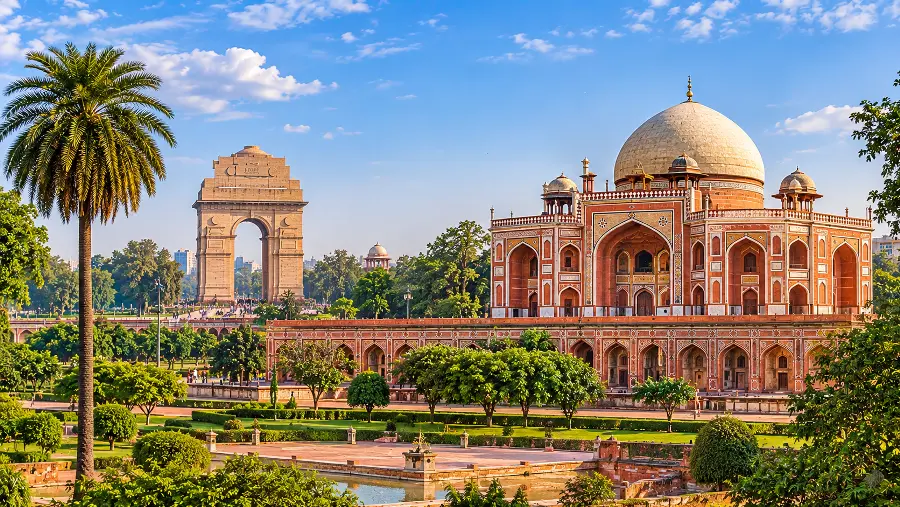
Delhi spreads over the plains beside the Yamuna, and New Delhi, India's capital, is just one district within it. People often ask how the two differ: Delhi is the whole capital territory, a place where sultans and emperors built one city after another over many centuries, while New Delhi is the government quarter of wide avenues that British planners laid out in the last decades of the Raj. Within a short metro ride you move from crowded bazaars under minarets to Sikh and Hindu temples, from royal tombs set in quiet parks to glass office towers. Three of its monuments, the Red Fort, the Qutb Minar and Humayun's Tomb, carry UNESCO status, and a fast train gets you to the Taj Mahal in a couple of hours. Here is what to see in Delhi if you want a first taste of India in just a few days: 20 places, from mosques and gardens to markets and a trip to Agra.
What to See in Delhi First
It helps to think of the city in three parts. Old Delhi in the north holds the Red Fort, the Jama Masjid and the Chandni Chowk bazaar. Central New Delhi has India Gate, Connaught Place and the Bangla Sahib gurdwara, and the south is where you find the Qutb Minar, Hauz Khas and the Lotus Temple. Distances are long and traffic is heavy, so the metro is the quickest way between districts, with auto-rickshaws or app taxis for the last stretch. Temples and mosques expect bare feet and covered shoulders and knees, and in gurdwaras everyone covers their head as well.
1. Red Fort
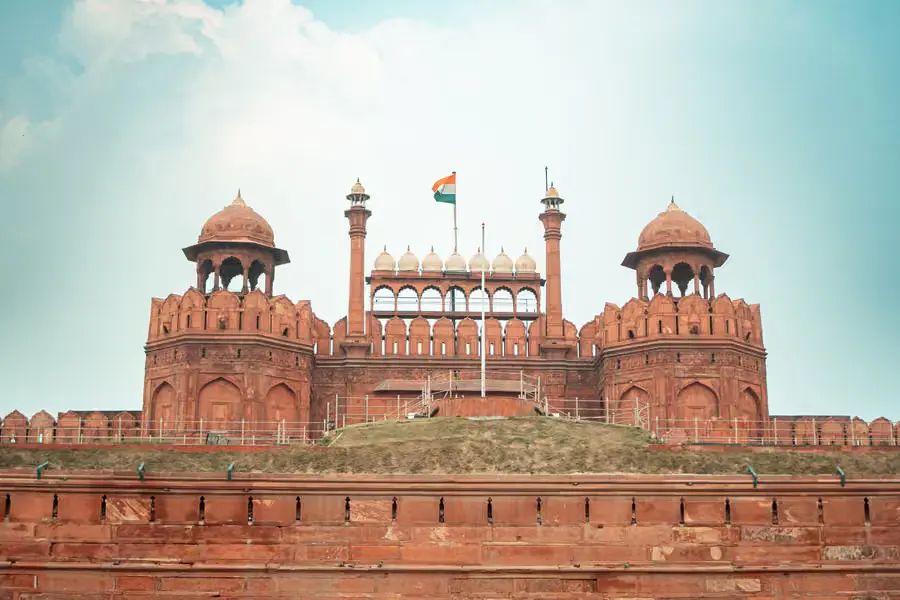
In 1639 Shah Jahan shifted his court north from Agra and ordered a palace-fortress of red sandstone as the heart of a new capital. You still enter through the Lahori Gate and the vaulted Chatta Chowk arcade, where merchants once sold silk and jewels to the court; today the stalls carry souvenirs. Further in you reach the hall of public audience, Diwan-i-Am, where ordinary subjects brought their pleas, and the marble Diwan-i-Khas, the hall that held the Peacock Throne until the Persian ruler Nadir Shah sacked the city in 1739 and carried it away.
For Indians the fort stands for freedom. On the morning of 15 August 1947 Jawaharlal Nehru hoisted the tricolour over the Lahori Gate, and on every Independence Day since, the prime minister has addressed the nation from these walls. UNESCO listed the Red Fort Complex in 2007. Arrive soon after opening, while the stone is still cool, then walk or hop on a cycle rickshaw into Chandni Chowk.
2. Jama Masjid and Chandni Chowk
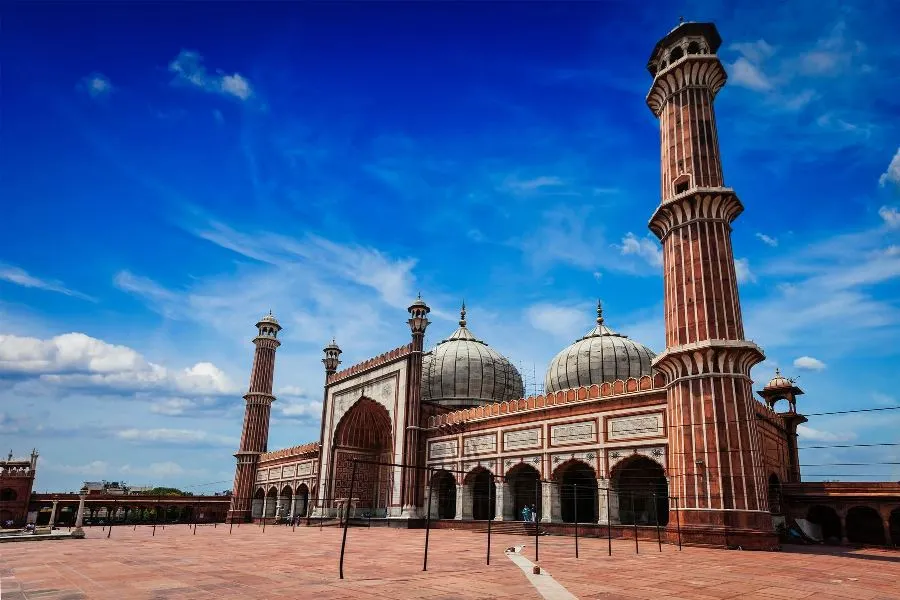
Shah Jahan placed his great mosque on the highest ground of his new city between 1650 and 1656, and its courtyard can take up to 25,000 worshippers at prayer. Two sandstone minarets flank three marble domes, and each tower has 130 steps with viewing galleries on the way up. From the top you look over a flat sea of rooftops, wheeling pigeons and the walls of the Red Fort. Arms and legs should be covered, shoes stay at the gate, and visitors are asked to wait outside during prayer times.
The street running from the mosque to the fort is Chandni Chowk, the "Moonlight Square" laid out by Shah Jahan's daughter Jahanara. A canal once ran down its centre and caught the moon at night; now it is a roaring bazaar of fabric, spices, silver and wedding finery, where a cycle rickshaw moves faster than any car. The Sis Ganj gurdwara on this street marks the place of Guru Tegh Bahadur's execution in 1675; he was the ninth of the Sikh gurus, and in the side lanes cooks fry stuffed parathas in bubbling ghee.
3. Qutb Minar
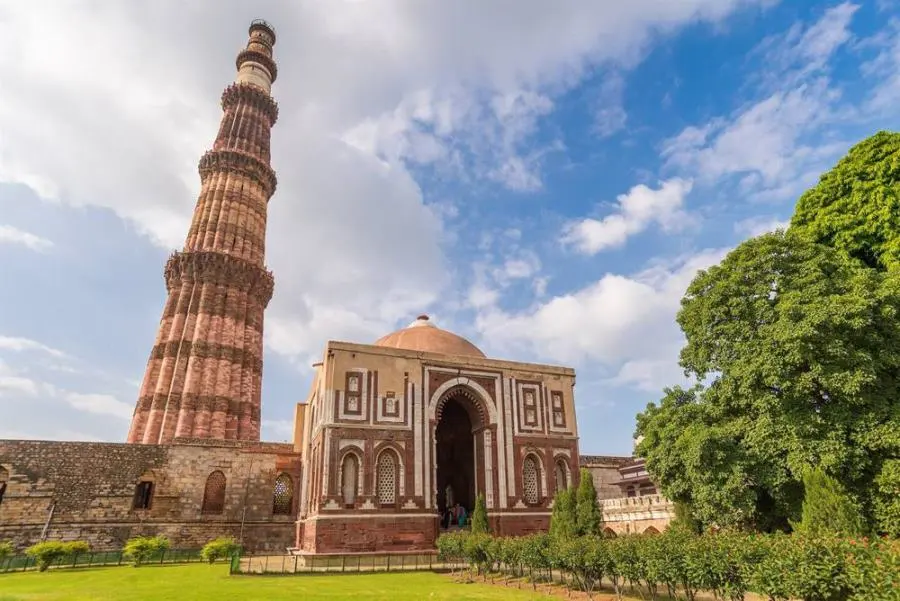
At 72.5 metres, this is the tallest brick minaret anywhere. It began as a victory tower: Qutb ud-Din Aibak, having overthrown Delhi's last Hindu king, started it around 1199 but completed only the first storey, and his successor Iltutmish carried on the work. Each of the five tiers alternates red and pale stone, the balconies rest on carved brackets, and bands of Arabic script wrap around the shaft.
Scattered nearby are the ruined Quwwat-ul-Islam mosque, the Alai Darwaza gateway with India's earliest true arches and dome, and the fat stump of a second tower, the Alai Minar, meant to be even taller but abandoned after its first storey. The real puzzle is the iron pillar, more than seven metres tall, cast in the reign of Chandragupta II over 1,500 years ago. Six tonnes of metal have barely rusted, and scientists still study the alloy.
4. Humayun's Tomb
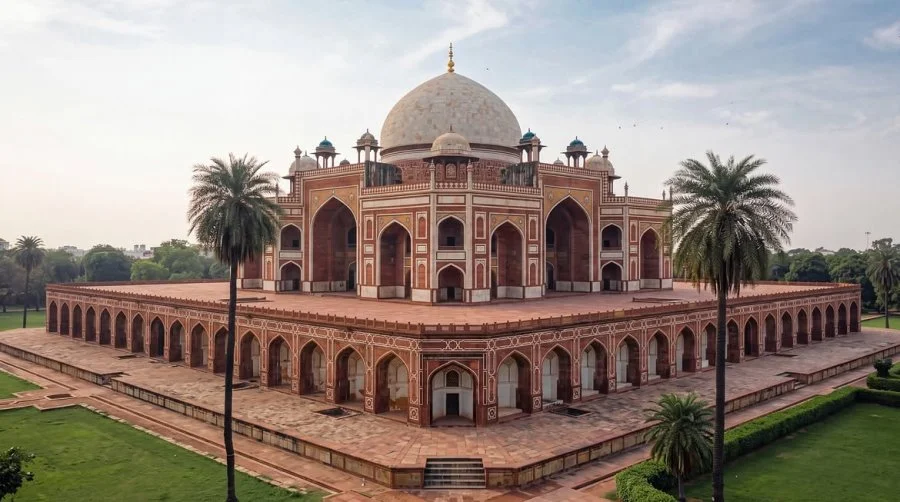
Bega Begum, widow of the second Mughal emperor, paid for this mausoleum, and the plans came from Mirak Mirza Ghiyas, an architect from Persia who worked alongside his son. It was the subcontinent's first garden tomb: water channels split the grounds into four quarters, and a double dome rises over red sandstone inlaid with white marble. The same formula reached its peak a few generations later at the Taj Mahal, which is why guides call this building its forerunner. It has been a World Heritage Site since 1993.
Near the entrance stands the octagonal tomb of the nobleman Isa Khan, built before the main mausoleum, and to the north is Sunder Nursery, a park of Mughal pavilions, ponds and shady walks. Give the area a whole morning: the gardens are calm, and towards sunset the sandstone glows warm orange.
5. Lotus Temple
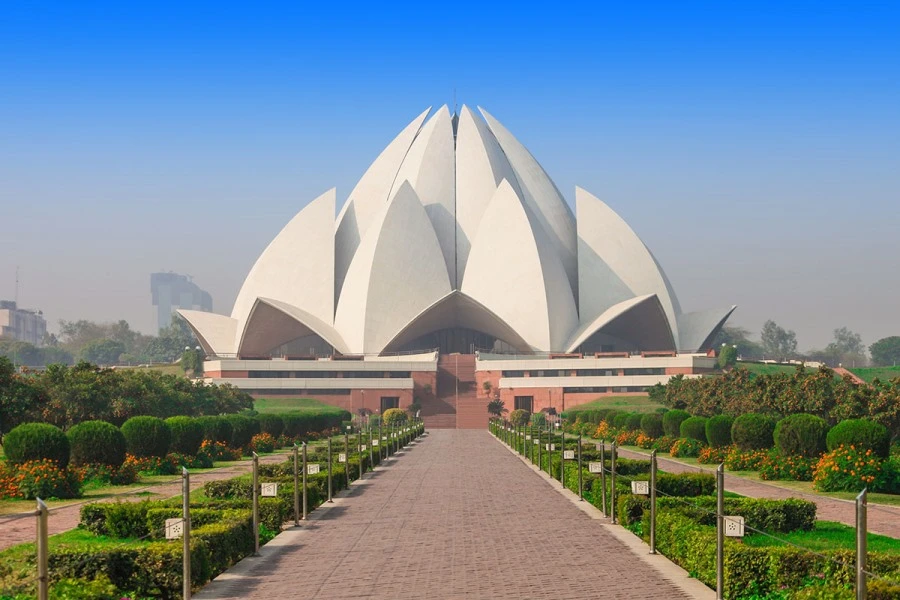
Architect Fariborz Sahba built this Baháʼí House of Worship from 27 separate petals clad in white marble. Set nine to a ring, in three rings circling the prayer hall, they make the building look like a flower caught just before it opens. The lotus was chosen because several of India's faiths hold it sacred, and the temple was dedicated in December 1986.
Anyone may go in, whatever their religion. There is no altar, no statue and no sermon: at set times readers recite passages from the scriptures of different faiths, and the rest of the day the hall is silent. Shoes are left at the entrance and visitors are asked to whisper. Almost every visitor to the capital comes here, so a weekday late afternoon is the best time, when the marble turns pink in the low sun.
6. Akshardham
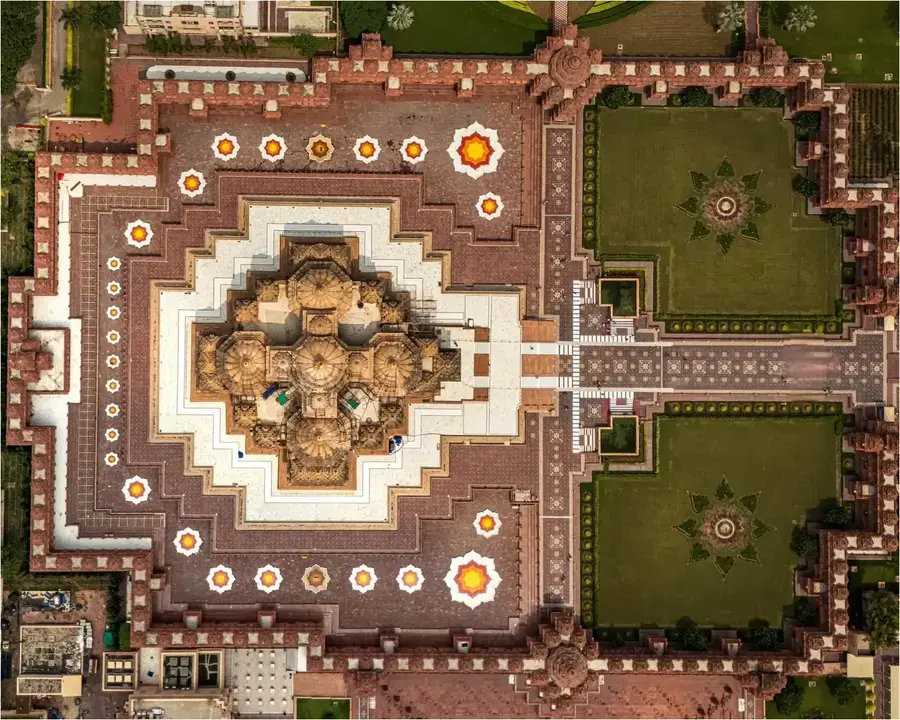
This temple complex on the east bank of the Yamuna opened in 2005, yet it follows ancient temple-building rules and is made of pink Rajasthani sandstone and Carrara marble. Thousands of figures cover the walls: elephants, dancers, sages, gods and flowers, carved so closely that hardly a smooth surface remains. It is dedicated to Swaminarayan, the founder of a Hindu devotional movement.
Expect strict security: phones, cameras and most electronics are not allowed inside, and everything goes into a cloakroom at the gate. In return you can spend half a day here, with exhibition halls, a boat ride past scenes from Indian history and a giant-screen film. After dark the Sahaj Anand water show retells old legends with fountains, light and music.
7. India Gate and Kartavya Path
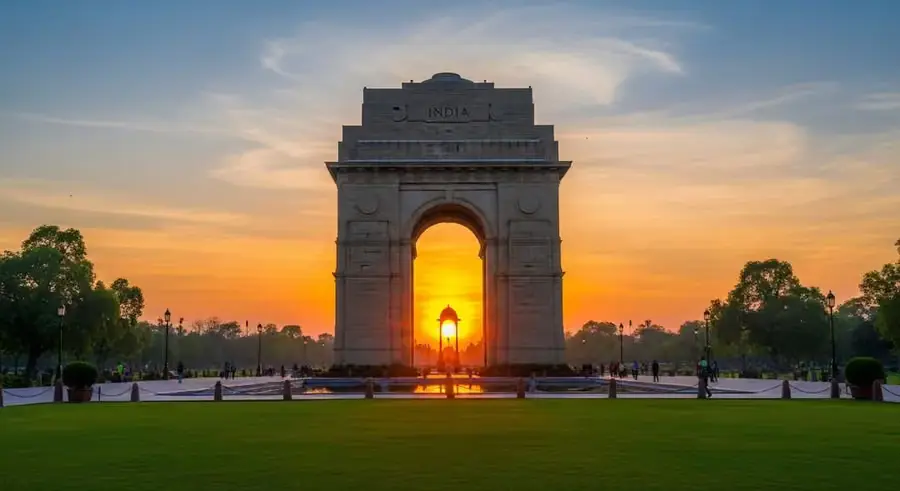
Edwin Lutyens designed this 42-metre arch to honour 74,187 Indian soldiers who lost their lives fighting for the British Empire in the First World War and on the Afghan frontier in 1919, and more than 13,000 names are cut into its stone. Next to it, the National War Memorial keeps an eternal flame for those who fell in later conflicts. In the evening, with the arch lit up, families stroll the lawns among ice-cream carts and balloon sellers.
West of the gate runs Kartavya Path, the ceremonial avenue once called Rajpath, where the Republic Day parade marches every 26 January. It climbs Raisina Hill to Rashtrapati Bhavan, a 340-room palace that Lutyens and Herbert Baker built for the British viceroy and that now houses the President of India. Domed government blocks with long colonnades line both sides of the slope.
8. Lodhi Gardens
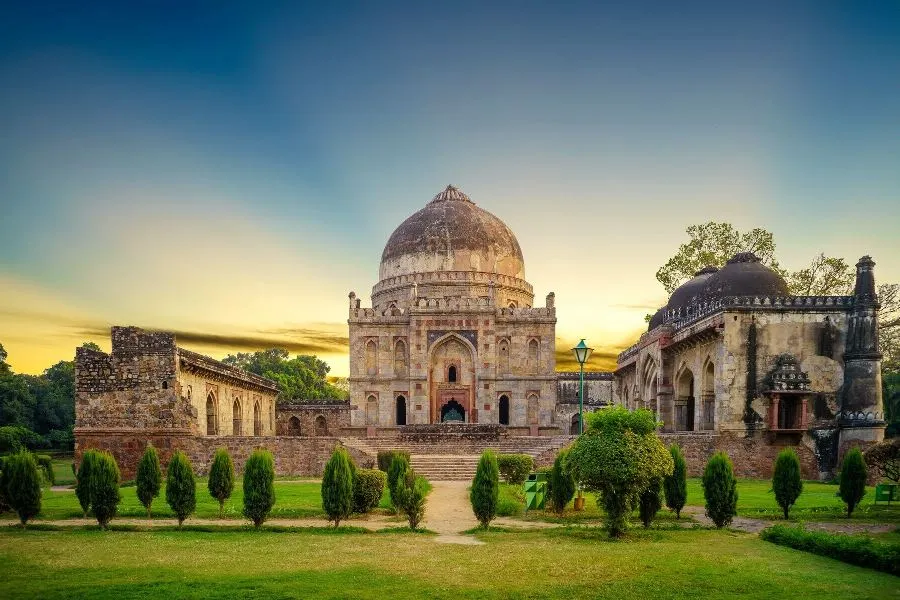
Covering some 36 hectares, wedged between Khan Market and the tomb of Safdarjung, this park shelters tombs of two sultan dynasties, the Sayyids and the Lodis. Look for Muhammad Shah's eight-sided tomb, the walled resting place of Sikandar Lodi and the Bara Gumbad, raised in 1494 together with its mosque. The Shisha Gumbad still shows patches of blue glazed tile, which earned it the name "glass dome".
Locals love it. Joggers and yoga groups arrive at dawn, picnics fill the lawns at midday, and by evening students settle by the pond with their books. Parakeets dart between the domes and mynas chatter in the trees. Afterwards, Khan Market next door has bookshops and good coffee.
9. Gurudwara Bangla Sahib
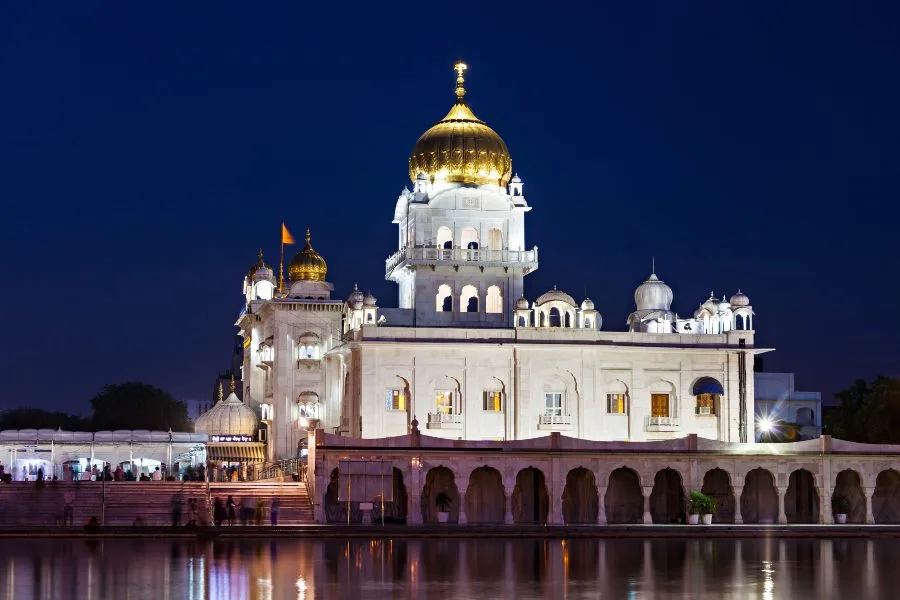
The white shrine with its golden dome occupies the site of a bungalow owned by Jai Singh I, the ruler of Amber, where Guru Har Krishan, eighth in the line of Sikh gurus, stayed in 1664. Tradition says he tended the sick during an epidemic, and Sikhs consider the water of the sarovar, the pool that mirrors the building, to be healing. Pilgrims walk slowly around it while hymns accompanied by harmonium and tabla drift out of the hall.
Everyone is welcome. Free headscarves wait at the entrance, shoes are checked in, and you rinse your feet in a shallow channel of water before entering. Do visit the langar, the community kitchen where volunteers serve free meals of rice, lentils and flatbread to thousands of people every day. Guests may join in rolling chapatis, which many travellers remember longer than any guided tour.
10. Agra and the Taj Mahal
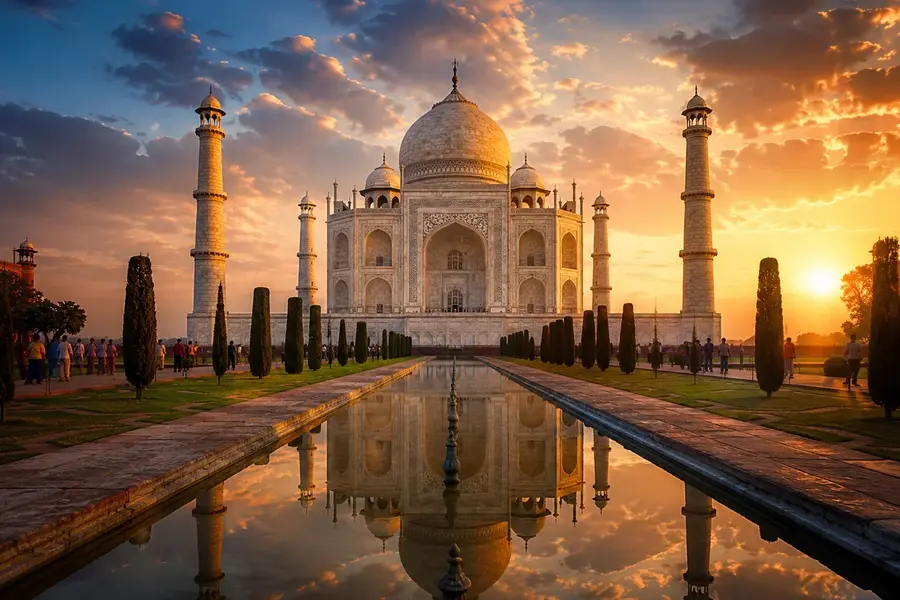
Agra lies roughly 230 kilometres south-east of the capital, and a day trip there is the most popular excursion from Delhi. Shah Jahan began the Taj Mahal after the death of his beloved wife Mumtaz Mahal, and the whole ensemble of garden, mosque and guest hall was finished in 1653. Our separate article on the Taj Mahal covers its legends and the story of its construction. Note, though, that the complex shuts to tourists every Friday.
The fastest way there is the Gatimaan Express from Hazrat Nizamuddin station, which takes under two hours, while the Yamuna Expressway by car means three to four hours. Leave as early as you can: at sunrise the marble is pink and the crowds are thinner. While in Agra, see the Agra Fort as well, which Emperor Akbar rebuilt between 1565 and 1573; from its terraces the Taj appears beyond a bend in the river.
Delhi Landmarks: What Else to See While You're in the City
- Laxminarayan Temple — known as Birla Mandir after the industrialist family that paid for it; Gandhi agreed to open it only if people of every caste could enter.
- Jantar Mantar — an open-air observatory built for Jai Singh II, the ruler who founded Jaipur, with 13 instruments shaped like giant staircases, arches and bowls for tracking time and the stars.
- Nizamuddin Dargah — a Sufi shrine in an old neighbourhood where qawwali singers perform on Thursday evenings, close to the grave of the poet Amir Khusrau.
- Connaught Place — a white ring of colonial colonnades at the city's centre, full of shops and restaurants above the Rajiv Chowk metro interchange.
- Hauz Khas — a medieval reservoir with the ruins of a madrasa above the lake, next to a village of bars, galleries and young designers' boutiques.
- Safdarjung's Tomb — the garden mausoleum of a Mughal prime minister, built in 1754 as the empire was already fading.
- Agrasen ki Baoli — a 60-metre stepwell tucked between office blocks a short walk from Connaught Place.
- Raj Ghat — a plain slab of black marble, with a flame that never goes out, marking the place of Mahatma Gandhi's cremation; the house where he was killed is now the Gandhi Smriti museum.
- Purana Qila — known simply as the Old Fort, raised by Humayun and Sher Shah Suri, with a mosque, the octagonal Sher Mandal library and a lake for boating.
- Jaipur — Rajasthan's "Pink City", with the 953-window Hawa Mahal and Amber Fort, the third corner of the Golden Triangle with Delhi and Agra.
What to See in Delhi in 1 Day, 2 Days or 3 Days
Is three days enough for Delhi? It covers the essentials without rushing, and with Agra added, four days work better. With a single day, start at the Red Fort, climb a minaret of the Jama Masjid, ride a rickshaw through Chandni Chowk, take the metro to India Gate for sunset and finish at Connaught Place after dark. On day two, visit Humayun's Tomb, the Nizamuddin quarter and Lodhi Gardens, then go on to the Lotus Temple after lunch and wait at Akshardham for the fountain show. Day three is for the Qutb Minar and Hauz Khas, or for the Taj Mahal, as long as it isn't a Friday.
When should you go? October, February and March bring the kindest weather. From April to June the heat is brutal, with daytime highs around 42 °C in late May, and the monsoon rains arrive as June draws to a close. November to January is dry and cool, but smog and thick fog often hang over the city, so check the air quality index and pack a mask. In autumn India celebrates Diwali, when streets glow with oil lamps and strings of lights. On a longer trip, Delhi is a good starting point for Varanasi on the Ganges, Rishikesh beneath the Himalayan foothills or the forts of Rajasthan.
Several of the best Delhi attractions cost nothing: the Lotus Temple, Bangla Sahib and its langar, the grounds of Akshardham, India Gate, Lodhi Gardens, Raj Ghat and the Nizamuddin shrine. Children enjoy the rail museum in Chanakyapuri with its steam engines and toy train, the boat ride at Akshardham, Shankar's collection of dolls from around the world and the Dilli Haat craft market, where food stalls serve dishes from different states. As for food, try chaat with crunchy pani puri, parathas filled with potato or paneer, kebabs from the grills around the Jama Masjid, masala chai, lassi and hot jalebis. Locals claim that butter chicken was first cooked here, in the old Daryaganj district. Stick to bottled water and eat where the queue is made of locals. For an evening out, listen to qawwali at the Nizamuddin shrine or join the late crowds in the bars of Hauz Khas and Connaught Place.
No airline links Ukraine and India directly, but LOT Polish Airlines flies nonstop to Delhi from Warsaw, a journey of about seven hours. Other handy options connect in Istanbul or Dubai. Indira Gandhi International Airport sits 16 kilometres south-west of the centre, and the Airport Express metro line takes twenty to thirty minutes to New Delhi station. Travellers with Ukrainian passports must obtain a visa for India, which is issued through the Indian government's online portal or at an Indian embassy.
After Delhi's heat and noise, nothing restores you like the ocean, and Indians themselves know where to find it: Sri Lanka welcomes more visitors from India than from any other country, and the coral atolls of the Maldives lie close by. Consultants with the TurPoisk online travel agency are ready to put together tours to Sri Lanka with tea plantations and beaches, or Maldives holidays in a villa over the lagoon. Our team will gladly book a hotel in Delhi too, so that the capital and the ocean become one trip. To see what your own dates would cost, use the online tour search. And if you are still torn between sightseeing and the beach, tell us your plans and we will shape the journey so there is time for both Agra's marble and the sea.


