

Petra (or Al Batra in Arabic) is an ancient city located in southwest Jordan. Historically, it was the capital of Idumea, and later of the Nabataean kingdom. Petra rises more than 900 meters above sea level in the narrow Siq canyon, and is located just 236 kilometers from the modern capital of Jordan, Amman.
This ancient city of Petra is one of the new wonders of the world and is recognized by UNESCO as part of the World Heritage Site. Millions of tourists come here every year to see this rock city with their own eyes. The impression remains incredible, and it’s hard to believe that this amazing place was created several thousand years ago.
History of the ancient city of Petra
The history of the city of Petra, located in Jordan, goes back more than a thousand years. Its beginning was marked in the 18th century BC, when the Edomites settled here, whose traces remained in many buildings. The following periods include the reign of the Nabateans (from the 2nd century BC to 106 AD), subsequent influence of the Romans, Byzantines and Arabs. In addition, in the 12th century AD. Petra was under the control of the crusaders.
Who built Petra and when
The translation of the name of the city of Petra from Greek means “rock”, and this is quite logical, because this ancient city is completely carved out of stone. It is also called the “pink” city because at sunrise and sunset the rocks take on amazing scarlet and pink hues.
The rock city of Petra got its start thanks to the Nabateans, Arab nomads who skillfully controlled the flow of water, which was vital to the area. When seasonal rainfalls and floods came, the people of Petra used cisterns and aqueducts, which not only helped them survive droughts, but also generated income by selling water to travelers.

At that time, Petra occupied an advantageous position, being at the junction of strategically important trade routes. One of them connected the Persian Gulf with Gaza, and the other connected the Red Sea with Damascus. Caravans overloaded with precious spices braved the harshness of the Arabian desert for weeks. Their reward was the hidden Siq Canyon, which led into Petra itself.
For many centuries, the spice trade brought huge profits to the city. However, after the Romans opened sea routes to the East, land caravans gradually ceased to be viable, and Petra became a forgotten city, buried under the sands.
Would we have known about the existence of this forgotten city if not for a traveler from Switzerland named Johann Ludwig Burckhardt, who accidentally discovered and described this amazing place in 1812?
Sights of the stone city of Petra
Petra, a city carved in stone, has amazing sights that reflect ancient times. Among them are temples, tombs, baths and colonnades - more than 800 monuments that testify to the efficiency and talent of its first inhabitants.
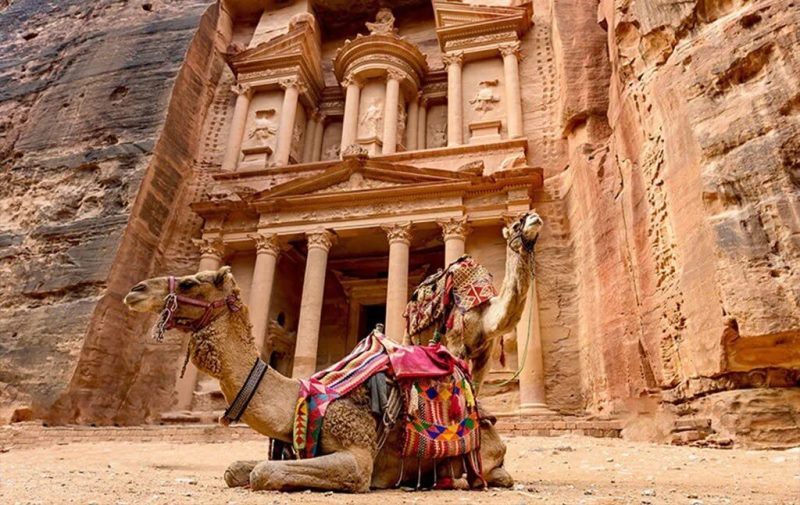
To appreciate this wonderful world, you need to walk several kilometers through the picturesque Siq Gorge, and this should be done on foot. At the very beginning of your journey, you will be surrounded by sheer cliffs, creating amazing dark corridors. As soon as you leave this labyrinth, your gaze will fall on Al Khazneh.
El Khazneh is one of the most significant sights in Petra, this is a tomb that served as the burial place for one of the Nabataean kings. This magnificent building is carved into the rock, its graceful pediment and towering columns leave you in awe. How builders in ancient times were able to erect such a majestic structure without access to scaffolding (there were no trees in these places) and modern equipment remains a mystery. There is a version that El-Khazneh could serve as a temple to the goddess Isis.
As you walk around the rock in which the palace is carved, you will discover an impressive array of stone structures. Here you will find former residential buildings, stone stairs, arches, and even a Roman amphitheater that can accommodate close to 4,000 spectators.
The city has two archaeological museums, as well as many sacred sites associated with biblical history, such as Mount Aaron, which is said to have been visited by the high priest, and the Wadi Musa valley. The Ain Musa (Moses) spring is also located in this area. In the grounds you can find Qazr al-Bint, an important temple of the Nabataean kingdom.
Another amazing attraction, striking in its beauty, is the Ed-Deir Monastery, located on the top of a cliff. This majestic structure rises to a height of about 45 meters and has a width of 50 meters. There is only one room inside the monastery, and a staircase leads to a niche. Previously, on the square in front of Ed-Deir there were columns where various religious ceremonies were held. Now this place has a cafe for tourists, where you can hide in the shade and enjoy the atmosphere of antiquity while enjoying a cool drink.
Excursions in Petra: discover all the beauties of the city
A trip to Petra can be organized independently or with the help of guides. It is important to note that one day may not be enough to fully explore all the attractions. In this case, it is worth considering the option of staying at a hotel in the neighboring city of Wadi Musa, where all the tourist infrastructure is concentrated. There are about 40 hotels in Wadi Musa, and prices start at $16 per night, with an average stay of $70.
What you can bring as souvenirs from your trip:
- Products using colored sand.
- Miniature figurines depicting famous landmarks.
- Jewellery and jewelry inspired by the beauty of Petra.

How to get to Petra
To get from Amman to Petra, you have several options to choose from. If you follow the Desert Highway, it will take you approximately 3 hours to get there. Another option is the "Royal Road", but the journey along it can take about 5 hours.
- By bus
A bus departs daily from Abdali Bus Station in Amman to Petra. It leaves in the morning at 06:30 and the journey takes approximately 3.5 hours. Return to Amman is scheduled for 17:00. The one-way fare is 10 Jordanian dinars (approximately $14).
- Minibus
Another option is to take a minibus from Wihdat Bus Station in Amman. Minibuses depart several times a day and the fare is 5 Jordanian dinars (approximately $7). The travel time is also about 3 hours.
- From other countries
If you are in Egypt or Israel, you also have the opportunity to visit Petra. Almost all travel agencies at resorts organize tours to Jordan.
More information about travel and tickets can be found on the official Petra website.
Ticket prices:
- 1-day ticket: 50 Jordanian dinars ($70)
- 2-day ticket: 55 Jordanian dinars ($77)
- For short-term visits (up to 24 hours): 90 Jordanian dinars ($127)
- Tour guide: 50 Jordanian dinars ($70)
- Night tour (from 20:30 to 22:00): 17 Jordanian dinars ($24)


