
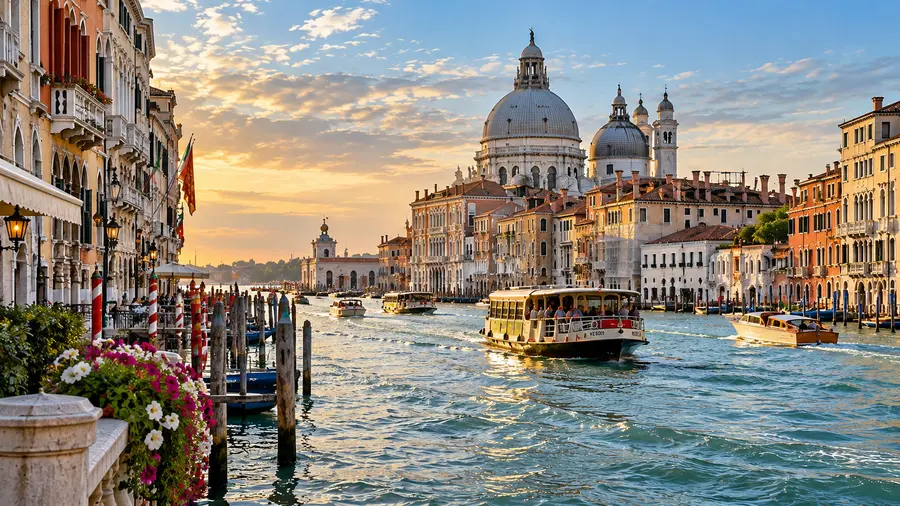
Venice swaps streets for canals, buses for vaporetto water buses and the hum of traffic for the slap of water against the marble steps of palaces. The city grew up on 118 small islands in a lagoon, linked by more than four hundred bridges, and for over a thousand years it was the capital of a maritime republic that traded across the Mediterranean and filled its churches with treasures from the East. That is why Byzantine gold sits next to Gothic arches here, and paintings by Titian and Tintoretto hang in ordinary parish churches. Still, Venice is not a stage set but a working city with markets, wine bars called bacari and laundry drying above the canals. On a first trip, the twenty places below show where to go in Venice and what to see over two or three days, with a clear route that also helps you dodge the crowds.
What to see in Venice first
The historic centre is split into six sestieri, or neighbourhoods: San Marco, Castello, Cannaregio, Dorsoduro, Santa Croce and San Polo. Cars stop at Piazzale Roma, trains arrive at Santa Lucia station, and from there you either walk or hop on a vaporetto, for which a multi-day pass quickly pays for itself. Keep a map on your phone, but do not worry about getting lost: yellow signs painted on the walls reading "Per Rialto" and "Per S. Marco" will steer you to the main sights. Most of them cluster around San Marco and the Grand Canal, so that is the natural place to begin your first day.
1. St Mark's Square and the Campanile
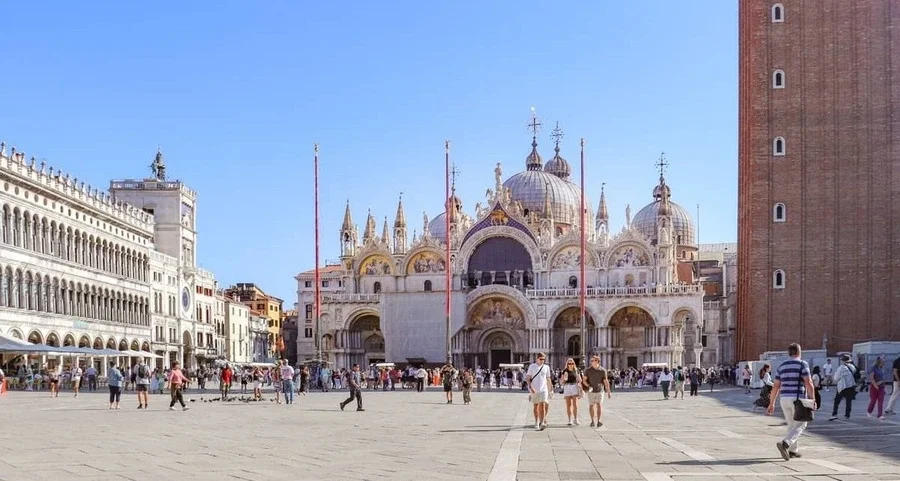
San Marco is the one square in the city that Venetians call a piazza; every other square is modestly known as a campo. Napoleon is said to have called it the most beautiful drawing room in Europe, and it is hard to disagree: arcaded Procuratie buildings frame it on three sides, Caffè Florian has served coffee under them since 1720, and over the archway into the Merceria shopping street rises the Clock Tower, where two bronze Moors strike the bell every hour.
Towering over the square is the basilica's 98-metre bell tower, the Campanile. It collapsed without warning in July 1902 and was rebuilt a decade later "where it was and as it was". A lift whisks you up in about a minute to a viewing gallery overlooking terracotta roofs, the lagoon and, on clear days, the snowy Alps. Get there soon after sunrise, while the square is still empty. Bear in mind that San Marco is the lowest point in the city: since 2020 the MOSE flood barriers have been raised against the worst tides, yet an ordinary acqua alta can still flood the piazza, sending visitors onto raised wooden walkways. Feeding the pigeons is banned.
2. St Mark's Basilica
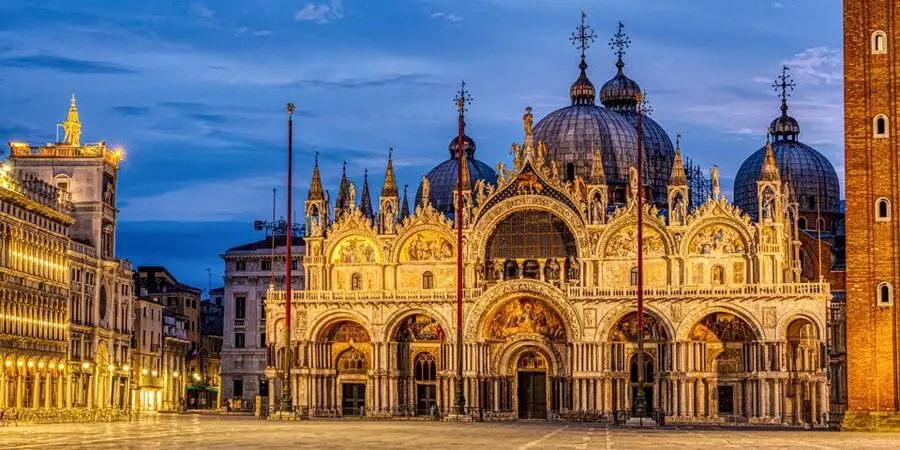
The story of the basilica begins with a theft. Legend has it that in 828 two Venetian merchants smuggled Saint Mark's remains out of Alexandria, hiding them under pork so that the customs officers would not search the cargo. The present church was consecrated in 1094, modelled on the Holy Apostles church in Constantinople, and each generation added more splendour. Its vaults and domes are lined with mosaics set on gold, stretching over more than eight thousand square metres, which explains the nickname "Church of Gold".
Behind the high altar glitters the Pala d'Oro, a golden altarpiece set with nearly two thousand gemstones, while the museum upstairs holds the original bronze horses carried off from Constantinople by crusaders in 1204. Napoleon took the four horses to Paris, but they came back in 1815; copies now stand on the loggia above the entrance, which offers a superb view over the square. Basilica tickets are sold online for a fixed time slot, so reserve yours in advance. Shoulders and knees must be covered, and large backpacks are not allowed inside.
3. Doge's Palace and the Bridge of Sighs
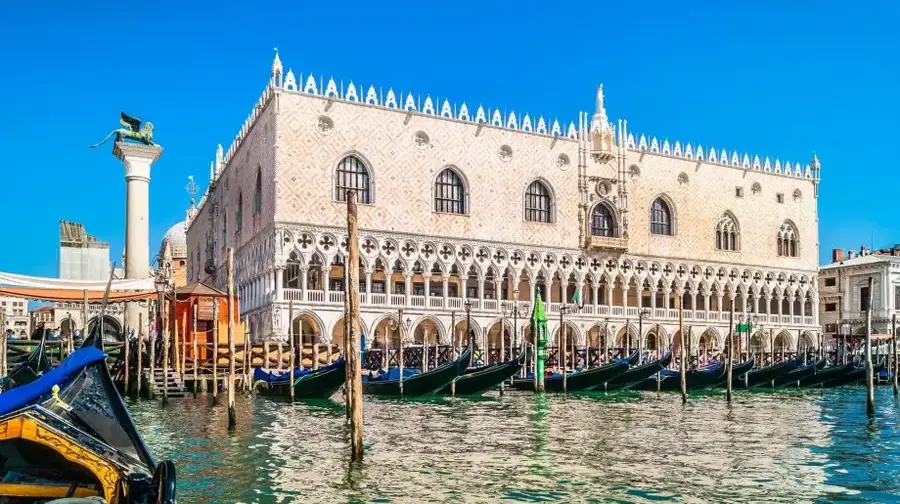
This pink-and-white palace with its lace-like arcades was for centuries the doges' residence, the parliament, the law court and the prison all at once; its Gothic shape dates largely from the 1300s and 1400s. Newly elected rulers of the republic climbed the ceremonial Giants' Staircase, watched over by Sansovino's colossal Mars and Neptune, and in the Great Council Hall Tintoretto's Paradise, among the largest oil paintings ever made, fills the wall behind the doge's throne. A frieze of doge portraits runs below the ceiling, but one space shows only a black shroud: Marino Faliero was beheaded in 1355 for plotting a coup.
The enclosed Bridge of Sighs, built around 1600, links the palace with the New Prisons. Romantic writers of the 1800s gave it its name, imagining prisoners catching a last glimpse of the lagoon through its stone grilles. It was from the lead-roofed cells under the palace roof that the adventurer Casanova famously escaped in 1756. To see the attics, the torture chamber and the offices of the secret police, book the Secret Itineraries tour, while the best-known shot of the bridge is taken from the neighbouring Ponte della Paglia.
4. The Grand Canal
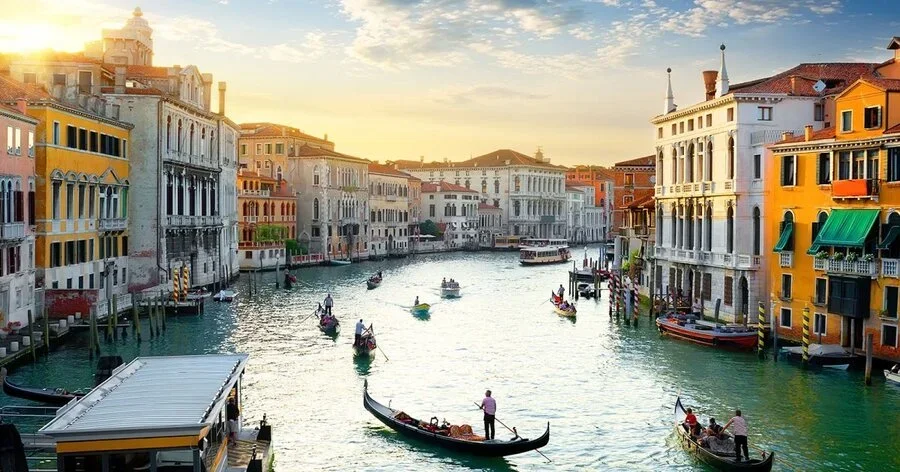
The city's main "street" curves in a reversed S for 3.8 km, from the railway station to the basin of San Marco. Some 170 palaces dating from the 1200s to the 1700s line its banks with their façades turned to the water, because guests and merchant barges once arrived by boat. Only four bridges cross it: the Scalzi near the station, the Rialto, the wooden Accademia Bridge and Santiago Calatrava's modern Constitution Bridge of 2008.
The easiest and cheapest sightseeing cruise is vaporetto line 1, which calls at almost every stop and covers the whole canal in roughly 45 minutes; grab a seat at the bow or stern. From the water you get a good look at Ca' Rezzonico, a museum of 18th-century Venice, Ca' Pesaro with its modern art gallery, and Gothic Ca' d'Oro with its lace-like façade. Where there are no bridges, cross the canal on a traghetto, a gondola ferry that carries passengers for a token fare.
5. Rialto Bridge and Market
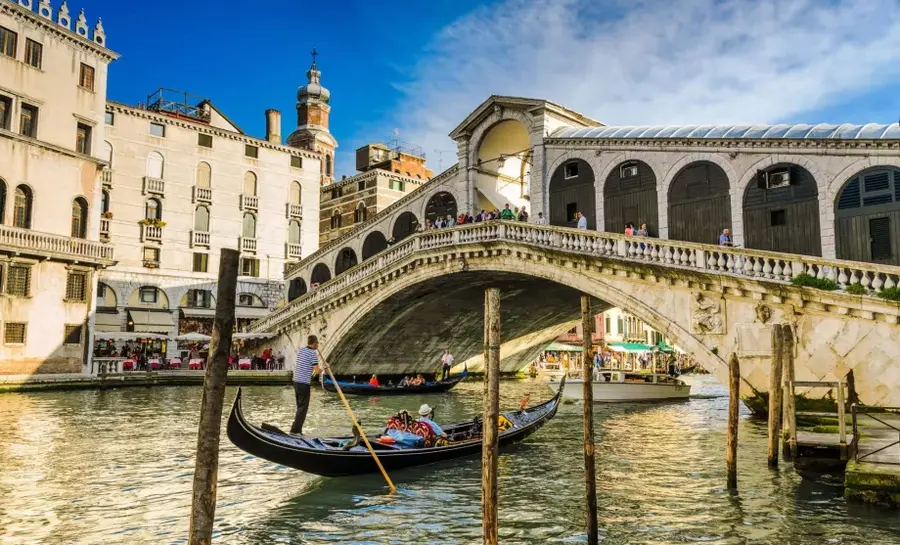
The Rialto is the oldest bridge over the Grand Canal and a symbol of merchant Venice. Earlier bridges here were made of wood, and one of them gave way in 1444 under a crowd watching a wedding parade. The stone arch lined with two rows of shops went up in 1588–1591 to a design by Antonio da Ponte, who, so the story goes, beat Michelangelo and Palladio in the competition. A restoration completed in 2016 has made the white Istrian stone shine again.
Beyond the bridge lies the Rialto Market, where Venetians have shopped for food for almost a thousand years. The fish stalls in the neo-Gothic loggia open on Tuesday to Saturday mornings, so come before noon to see the lagoon's fresh catch. In the surrounding bacari, order cicchetti, the Venetian answer to tapas, with a small glass of wine that locals call an ombra. Next to the bridge stands the Fondaco dei Tedeschi, the former trading house of German merchants, whose façade Giorgione and Titian covered with frescoes around 1508. The finest canal view, though, is from the Rialto itself at dawn or just before sunset.
6. Santa Maria della Salute
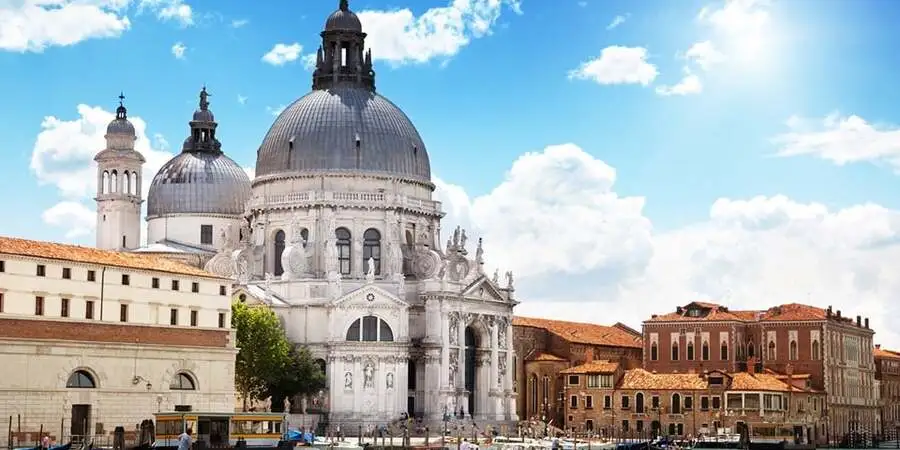
Rising at the point where the Grand Canal opens into the lagoon, this white octagonal church with its enormous dome was a vow the city made to the Virgin during the plague of 1630–1631, which killed one Venetian in three. Baldassare Longhena's design took over fifty years to complete, and chroniclers counted over a million wooden piles driven into the mud beneath it. The sacristy holds canvases by Titian and Tintoretto's Wedding at Cana.
Every 21 November, on the Festa della Salute, a temporary pontoon bridge is laid across the canal and Venetians walk to the church to light candles. At the very tip of the headland, the former customs house of Punta della Dogana has been turned by the Japanese architect Tadao Ando into a contemporary art gallery. From here the Zattere promenade begins, one of the loveliest spots for an evening stroll with gelato and views across to Giudecca.
7. Gallerie dell'Accademia
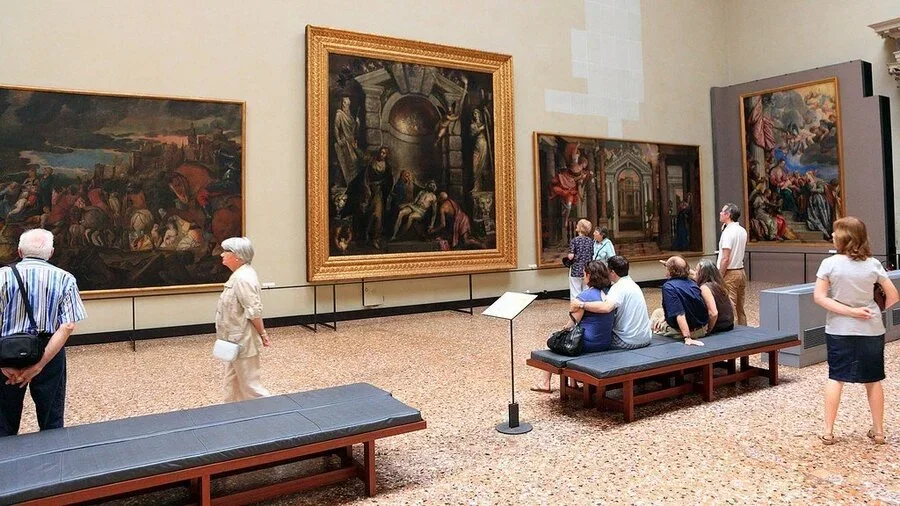
The most complete collection of Venetian painting from the 14th to the 18th centuries fills a former church, monastery and confraternity of Santa Maria della Carità. Walking through it, you can trace how the republic's art evolved: from gold-ground icons to Giovanni Bellini's Madonnas, Giorgione's enigmatic Tempest, Carpaccio's cycle of Saint Ursula and Titian's final Pietà. Veronese's vast Feast in the House of Levi started life as a Last Supper, but in 1573 the Inquisition objected to the jesters and dogs at the table, and the painter simply changed the title.
The gallery's archive keeps Leonardo da Vinci's Vitruvian Man, though it goes on display only rarely because the paper is sensitive to light. The museum is closed on Mondays, and one Sunday a month, the first, entry is free. Afterwards, linger on the wooden Accademia Bridge, which frames the postcard view of the Salute dome above the Grand Canal.
8. Frari Basilica and Scuola Grande di San Rocco
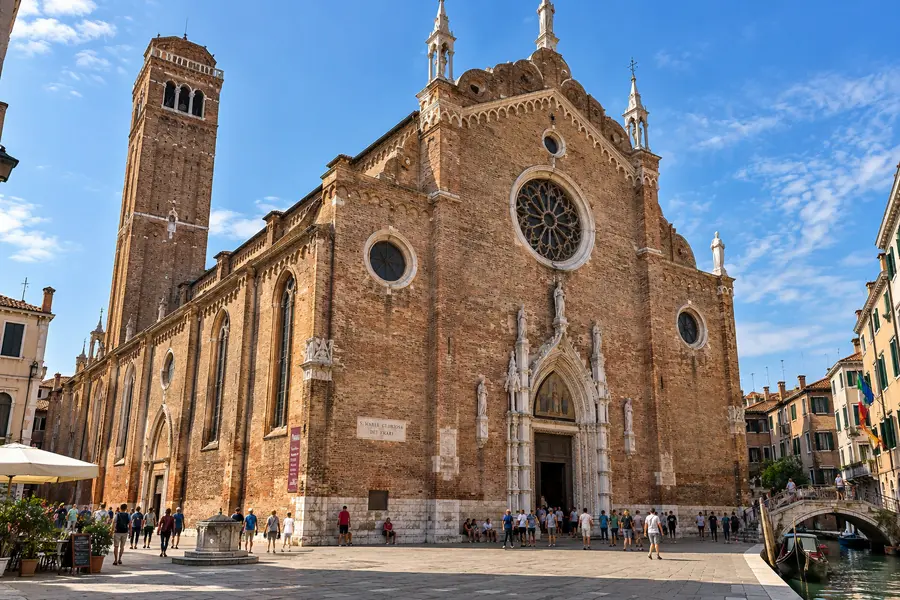
From outside, the brick Franciscan basilica of Santa Maria Gloriosa dei Frari looks austere, but inside waits one of the great Renaissance paintings: Titian's Assumption of the Virgin above the high altar, completed in 1518. His Pesaro Madonna hangs nearby, and Titian himself, who died during the plague of 1576, is buried in the church. The white marble pyramid opposite is the tomb of the sculptor Antonio Canova, based on a design he had once drawn up for Titian.
A few steps away stands the Scuola Grande di San Rocco, the hall of a charitable confraternity that Tintoretto spent more than twenty years decorating with dozens of canvases. The result has earned it the title of Venice's Sistine Chapel. The painted ceilings are so high that visitors are handed mirrors: you hold one in front of you and study the scenes without craning your neck.
9. Murano
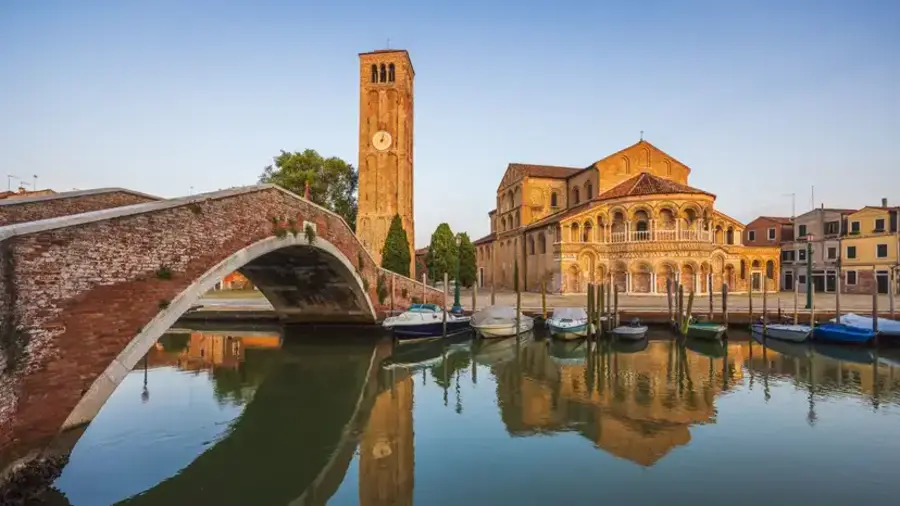
In 1291 the authorities ordered the glass furnaces moved out of the city to Murano, because frequent fires threatened the wooden houses. The island has been the world capital of glass ever since: its masters enjoyed privileges but were barred from leaving the republic in case they revealed the secrets of their craft. The Glass Museum in Palazzo Giustinian tells seven centuries of this story, and in many workshops you can watch a glowing blob turn into a horse or a vase within minutes.
Also step into the basilica of Santi Maria e Donato, with its mosaic floor of 1141: behind the altar hang bones that legend attributes to a dragon killed by Saint Donatus. Vaporetti to Murano leave from Fondamente Nove and take 10–15 minutes. Be wary of touts offering a "free taxi to the glass factory", and look for the "Vetro Artistico Murano" mark, because souvenir shops sell plenty of cheap imported glass.
10. Burano and Torcello
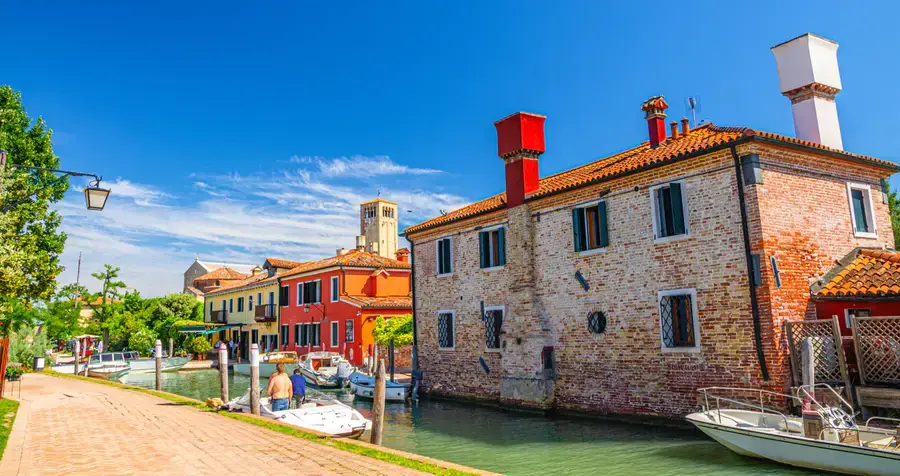
Burano is the most photogenic spot in the lagoon. Its fishermen's cottages are painted lemon, raspberry, turquoise and violet, and local legend says the bright colours helped men find their way home through the fog after a night at sea. Owners still cannot pick a colour freely: it has to be approved by the municipality. Besides the façades, Burano is famous for lace once made for European royal courts, which you can learn about in the Lace Museum, and the bell tower of San Martino leans visibly over the main square.
Vaporetto line 12 gets here from Fondamente Nove in about 40–45 minutes, stopping at Murano on the way, so the two islands make an easy day out together. Try risotto with goby fish and the S-shaped butter biscuits called buranelli, then cross in five minutes to quiet Torcello, the island where the story of the lagoon began. Only a handful of people live there now, but its cathedral of Santa Maria Assunta, founded in 639, keeps a huge Last Judgement mosaic, and near the entrance stands a stone seat known as Attila's Throne. On Burano the best light for photos comes in the morning, before the tour groups arrive, and late in the afternoon.
Venice Attractions: What Else to Visit While in the City
- San Giorgio Maggiore — Andrea Palladio's gleaming white church on its own island facing San Marco. A lift takes you up its bell tower for almost the same panorama as from the Campanile, without the queue.
- Peggy Guggenheim Collection — twentieth-century masterpieces in the unfinished single-storey Palazzo Venier dei Leoni, with works by Picasso, Kandinsky, Magritte, Dalí and Pollock. The American collector herself is buried in the garden beside her beloved dogs.
- La Fenice — an opera house that opened in 1792, burned down twice and, true to its name, rose again each time, most recently in 2003. Verdi's Rigoletto and La Traviata premiered here, and daytime tours take you through the auditorium and boxes.
- Cannaregio and the Ghetto — a lively residential district where the world's first ghetto appeared in 1516; the word comes from the Venetian geto, a foundry that once stood on the spot. In the evening locals gather on the Fondamenta della Misericordia and Ormesini, where bacari put tables out over the water.
- Arsenale and the Biennale — the former state shipyard, which in the Middle Ages built galleys on a true production line. Marble lions guard its gate, one of them brought from Piraeus in Greece by Admiral Morosini in 1687; in even-numbered years the Arsenale and the Giardini host the Art Biennale, in odd-numbered years the Architecture Biennale.
- Palazzo Contarini del Bovolo — a late 15th-century spiral staircase shaped like a snail shell, which Venetians call a bovolo. At the top, a small loggia looks out over the rooftops and domes of the centre.
- Libreria Acqua Alta — a bookshop that stores its stock in bathtubs, boats and even a gondola to keep it safe from high water. In the courtyard, old encyclopaedias have been stacked into a staircase, and cats doze between the shelves.
- Ca' d'Oro — the "Golden House", the finest Gothic palace along the Grand Canal, well worth seeing both from a boat and from inside. It was built in the 1420s for the merchant Marino Contarini, and its façade once gleamed with gilding and ultramarine. In the late 19th century Baron Giorgio Franchetti bought and restored the palace, later leaving it to the state together with his collection, which includes Mantegna's Saint Sebastian and fragments of the frescoes Giorgione and Titian painted on the Fondaco dei Tedeschi.
- Lido — an 11-kilometre sandbar between the lagoon and the Adriatic with beaches and Art Nouveau villas. Since 1932 it has hosted the Venice Film Festival, the oldest in the world.
- San Michele cemetery island — a peaceful island behind a brick wall where Sergei Diaghilev and Igor Stravinsky are buried; before the First World War Stravinsky spent his summers at his estate in Ustyluh, in today's Ukraine.
How many days do you need in Venice? Two or three suit a first trip perfectly. For one day in Venice, devote the morning to St Mark's Square, the basilica and the Doge's Palace, the afternoon to the Rialto and its market, and end the day aboard a vaporetto on the Grand Canal as the sun sets. On a second day, explore Dorsoduro with the Accademia, the Guggenheim, the Salute and the Zattere, plus San Polo with the Frari and San Rocco. Spend a third day on Murano, Burano and Torcello, and if you have longer, add the Lido or a train trip to Padua (about half an hour) or Verona (just over an hour). What can you do in Venice at night? Catch a Vivaldi concert in the composer's home town, see an opera at La Fenice, take a gondola at sunset or join locals for cicchetti in Cannaregio.
Many of the best free things to do in Venice are simply about walking: the squares, bridges and waterfronts, the Rialto Market and most churches, including the Salute and San Giorgio Maggiore, cost nothing, and state museums such as the Accademia waive their fee one Sunday a month. Families can watch glassblowers at work on Murano, visit the Natural History Museum with its dinosaur skeleton and the Naval History Museum by the Arsenale, and spend summer afternoons on the Lido beaches. Spring and autumn are the most comfortable seasons; summer is hot and crowded, acqua alta is common from November to January, and in February the city puts on its masks for Carnival. On peak days in spring and summer, mostly at weekends, day-trippers pay an access fee and register on the city's official website. Visitors staying overnight are exempt — one more reason to stay at least one night and see Venice without the crowds. Do not sit on bridge steps, swim in the canals or picnic in the squares, as all of these can earn you a fine.
Venice also pairs well with other Italian cities: high-speed trains reach Milan in two and a half hours or so, Florence in two and Rome in four, so take a look at our guides to Florence, Milan and Rome when planning an Italian route. In summer, fast catamarans also sail from Venice to Poreč, Rovinj and Pula on the Istrian coast of Croatia, perfect for a few beach days on the Adriatic after the canals.
Organising a trip to Venice? Let TurPoisk online travel agency handle the details: reserve a hotel in the city itself to avoid the access fee and catch San Marco at sunrise, or in Mestre, just ten minutes away by train. If you would like some sea time after Italy, our tour search lets you compare package offers from tour operators, for example to Croatia or Montenegro. Our team can advise you on how to combine cities and coast in a single trip.


