
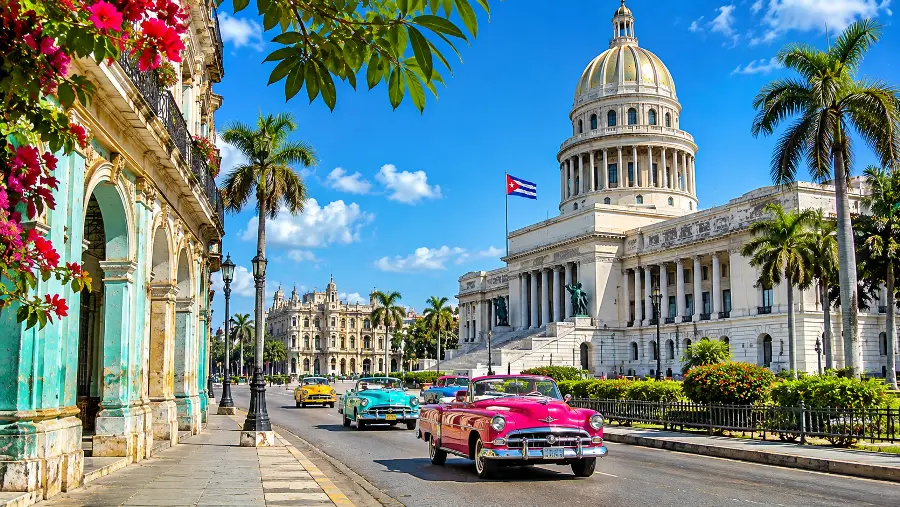
Cuba's capital, Havana, faces the Straits of Florida, at the spot where the Mexican Gulf spills into the Atlantic. The Spanish moved the settlement to its sheltered, deep-water bay in 1519, and within a few decades it became the meeting point for treasure galleons before the long crossing home. When Jacques de Sores, a French corsair, torched the town in 1555, Spain answered with stone: forts went up flanking the harbour mouth, and walls were built around the centre. The city's full Spanish name honours Saint Christopher, and one theory traces "Habana" to a local Taíno chief. So what is Havana famous for? Its colonial squares and old fortifications are protected by UNESCO as World Heritage, but the city is just as well known for a domed Capitol, hotels from the age of jazz and gangsters, 1950s American cars still working as taxis, rum, cigars and live music drifting out of almost every bar. This guide to what to see in Havana covers twenty places, from Cathedral Square to Hemingway's house, the Viñales Valley and the sands of Varadero.
What to See in Havana First
The part of Havana that visitors explore is a chain of neighbourhoods strung along the sea from east to west. Beside the bay lies Old Havana, Habana Vieja, with its four main squares, the pedestrian streets of Obispo and Mercaderes and most of the museums. West of it comes crowded Centro Habana, all peeling façades and laundry on balconies, then Vedado with its ruler-straight streets, university and mid-century hotels, and finally Miramar, where villas and embassies line Fifth Avenue. The Malecón seafront ties all of them together. Old Havana is a place for walking, while between districts you can take a yellow taxi, a round little coco-taxi shaped like half a coconut, or an open-top classic car hired by the hour for a sightseeing drive.
1. Cathedral Square and Havana Cathedral
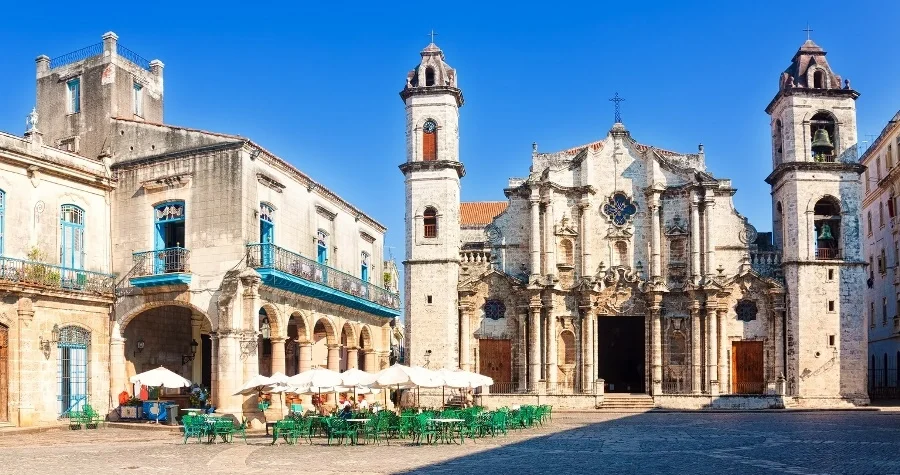
The prettiest square of the old town began life as a swamp: it was drained and first used as a shipyard. The Jesuits started the cathedral in 1748, and finished in 1777, a decade after King Charles III had thrown the order out of Spain's colonies. The Baroque front has two bell towers of unequal width and is built from blocks of coral stone, so if you look closely at the walls you can spot fossil shells and the imprints of sea plants.
From 1796 to 1898 the cathedral held Columbus's remains, which were shipped to Seville once Spain lost Cuba. Arcaded mansions of the colonial nobility frame the square. One houses the Colonial Art Museum, with period furniture and coloured glass, while outside the Lombillo Palace a bronze Antonio Gades, the flamenco star, strikes a pose. As evening falls, restaurant tables appear under the arches, and the square becomes one of the most atmospheric spots in town.
2. Plaza de Armas and the Real Fuerza Fort
The city's oldest square was its seat of power for centuries. Spanish captains general governed from the palace on its eastern side, which now holds the City Museum around a shady courtyard. In one corner stands El Templete, a small neoclassical temple said to mark the spot where the first Mass was held beneath a ceiba tree. Under the trees in the middle, second-hand booksellers spread out old books, postcards, coins and revolutionary posters.
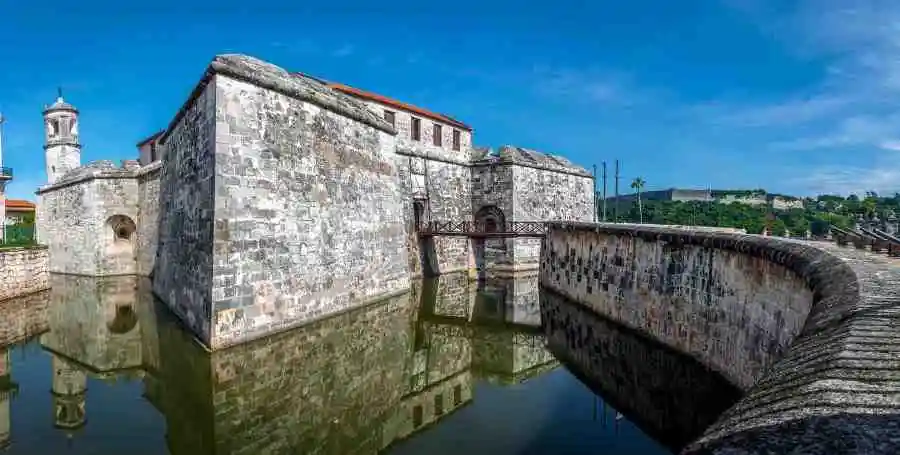
Next door rises the Real Fuerza fortress, completed in 1577 and regarded as the earliest stone fortress anywhere in the Americas. Its thick sloping walls, water-filled moat and drawbridge are still intact, and a bronze weather vane of a woman, La Giraldilla, turns on top of the tower. Legend says she is Isabel de Bobadilla, who spent years watching from the tower for the ships of her husband, the conquistador Hernando de Soto, who never came back from his expedition to Florida. The original vane is kept in the museum inside, and the Giraldilla went on to become Havana's symbol.
3. Plaza Vieja and Plaza de San Francisco
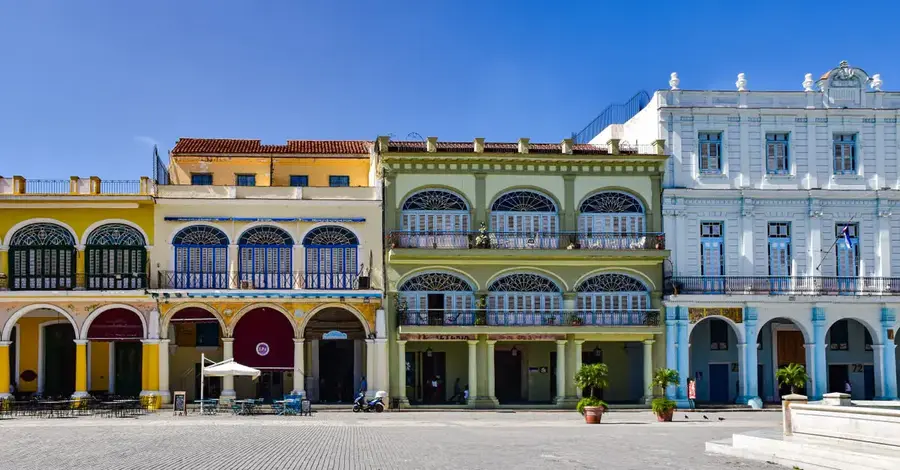
Plaza Vieja means "Old Square", although in the 16th century, when it was laid out, people called it the New Square. Unlike its neighbours it had no cathedral and no governor's palace; it was a market place, used for fairs, processions and celebrations. Houses from different eras surround it, from colonial Baroque to Art Nouveau, with balconies and half-moon stained-glass windows above the doors. On the top floor of one building a camera obscura uses lenses and mirrors to project a live panorama of Old Havana onto a screen.
A few blocks east, by the cruise and ferry piers, is the square of San Francisco, named after Saint Francis of Assisi and founded in 1628. Its centrepiece is the marble Fountain of the Lions, carved in 1836 by the Italian sculptor Giuseppe Gaggini, and above the rooftops rises the bell tower of the Basilica of Saint Francis, which now hosts classical concerts. Outside the basilica you'll meet a bronze figure of El Caballero de París, a gentle vagrant the whole city once knew; rubbing his beard is meant to bring good luck.
4. El Capitolio and the Gran Teatro
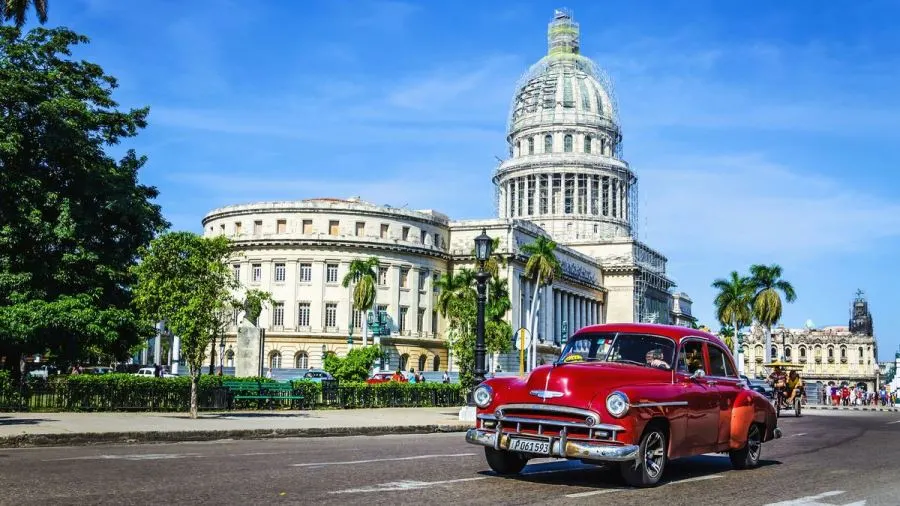
El Capitolio was built between 1926 and 1929 under President Gerardo Machado, and at 207 metres long it instantly dominated the skyline of the centre. Its architect said the cupola was inspired by the Panthéon in Paris, and when it was finished it ranked among the three highest domes in the world. Under the dome stands La República, a bronze giantess cast in Rome and gilded, said to be the world's third-biggest statue under a roof. A copy of a 25-carat diamond set into the floor marks kilometre zero for every road in Cuba.
Across the street, on the corner of Parque Central, stands the Gran Teatro, a flamboyant building with corner towers, built in 1914 as a club for Galician immigrants. The sculptures on its façade, which personify charity, education, music and drama, are by the Italian artist Giuseppe Moretti. Today it is the home of the Cuban National Ballet, led for decades by the legendary ballerina Alicia Alonso, and the main hall is named after Federico García Lorca. To see the interiors, come for a ballet night.
5. The Malecón and Paseo del Prado
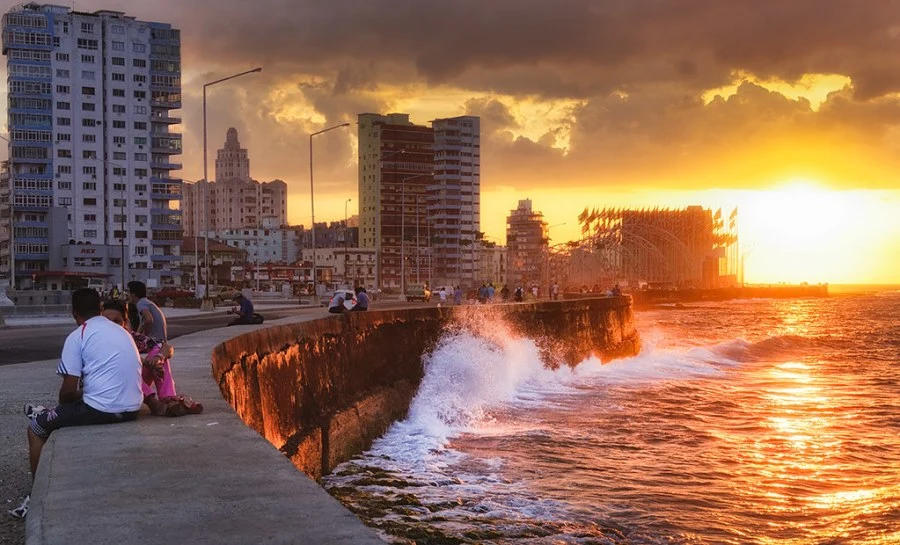
Work on the seawall began in 1901 to shield the houses from the waves that, when cold northern fronts blow in during the winter, crash over the parapet and flood the road. Today the Malecón runs for almost eight kilometres from Old Havana to Vedado, and this is where the city spends its evenings: couples and groups of friends perch on the stone wall, anglers cast their lines and musicians play for passers-by. Come at sunset, when the façades turn pink and polished Chevrolets and Fords from the 1950s cruise past.
From the sea to the Capitolio runs the Paseo del Prado, the old boundary between the walled town and the new districts beyond it. In 1925 the landscape designer Jean-Claude Nicolas Forestier from France turned it into a promenade with trees, marble benches and a raised walkway down the middle, and three years later came the bronze lions, cast from the metal of decommissioned cannons. At weekends local painters display their work here, while children roller-skate and kick footballs around.
6. Morro Castle and La Cabaña
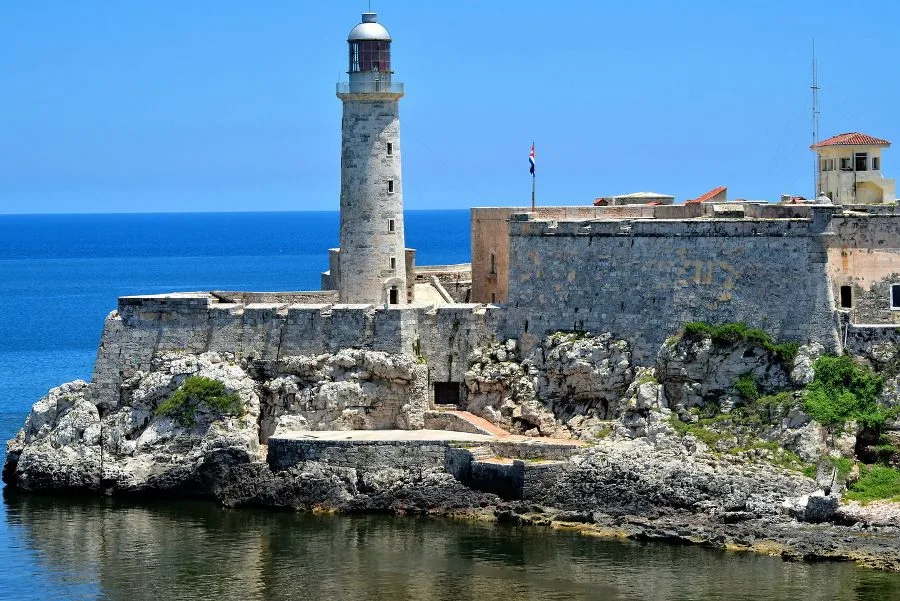
On the rocky headland facing Old Havana stands El Morro, whose full name invokes the Three Kings, begun in 1589 after raids by English pirates. At night a chain used to be stretched from here to the smaller La Punta fort on the opposite shore, sealing the harbour mouth to any ship. In 1762, after a long siege, the British took the castle, but a year later Spain got Havana back by handing over Florida in exchange. A 19th-century lighthouse crowns the point, and the ramparts give you the best view of the Malecón and the city skyline.
After the British siege, Spain built the vast La Cabaña fortress on the neighbouring hill. Completed in 1774, it was among the biggest colonial forts in the New World. In early 1959 Che Guevara set up his headquarters here, and his former office is now a small museum. Every evening at nine the walls host the cañonazo ceremony: gunners in 18th-century uniforms load a cannon to the beat of a drum and fire it, just as the shot once signalled that the city gates were closing. Come in good time, as the places along the wall fill up quickly.
7. Museum of the Revolution
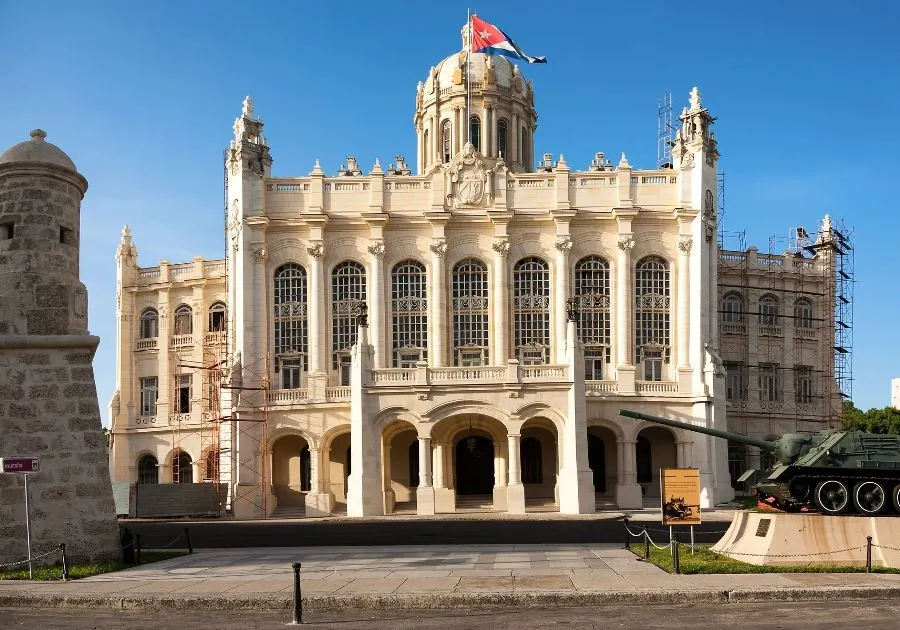
The museum occupies the former Presidential Palace, opened in 1920, whose interiors were fitted out by New York's Tiffany Studios, with a Hall of Mirrors that recalls Versailles. Every Cuban president worked here up to Fulgencio Batista, and in March 1957 a group of student revolutionaries stormed the palace in an attempt to kill him. The bullet holes in the marble stairs and walls were deliberately left unrepaired.
The displays cover Cuba's independence wars against Spain and the revolution through weapons, photographs, letters and the personal belongings of the rebels. Behind the palace, inside a glass pavilion, sits the yacht Granma, which in November 1956 carried 82 fighters under Fidel Castro across from Mexico. A tank, aircraft and vehicles used in the fighting are parked around it, so there is plenty to see even if you don't read Spanish.
8. Revolution Square
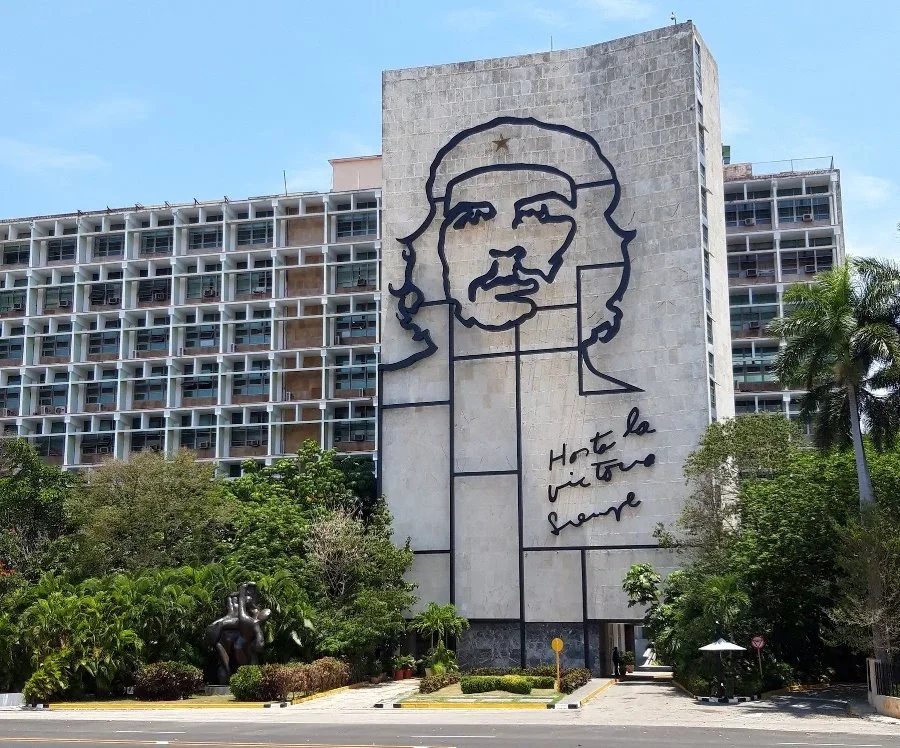
Revolution Square covers 72,000 square metres and has always been the stage for the country's biggest gatherings: Fidel Castro addressed crowds of a million people here, and two popes, John Paul II in 1998 and Francis in 2015, said Mass on it. Government buildings line the square, and two of them carry giant steel outlines of revolutionary heroes: Che Guevara above the words "Hasta la Victoria Siempre", always until victory, and Camilo Cienfuegos beside "Vas bien, Fidel", meaning you're on the right track, Fidel.
Rising above it all is the José Martí Memorial, a tower shaped like a five-pointed star and faced with grey marble from the Isle of Pines. At 109 metres the tower is among the city's highest points. A huge seated statue of Martí, the poet and hero of the independence struggle, guards its base, a museum fills the interior, and a lift carries you up for views over Havana as far as the sea.
9. Vedado and the Hotel Nacional
Vedado was laid out as a grid of 100-metre blocks and shows best what Havana looked like before the revolution: Art Nouveau and Art Deco villas, 1950s high-rises and leafy streets. Its main artery is Calle 23, nicknamed La Rampa, which slopes down to the sea past cinemas, cafés and the former Havana Hilton, once the highest hotel anywhere in Latin America. Here too is Coppelia, an ice cream parlour named after the ballet and housed in a modernist pavilion from 1966, and just uphill stands the University of Havana, founded in 1728, with its grand flight of steps.
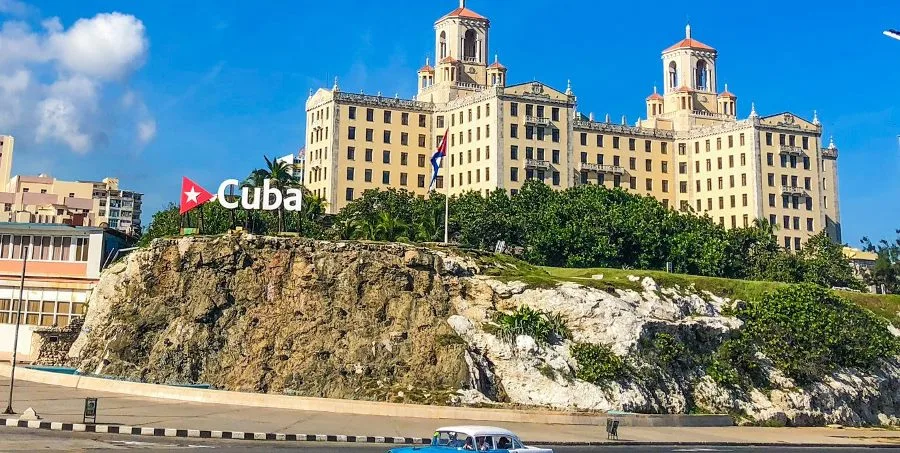
On a hill above the Malecón sits the Hotel Nacional, which opened in 1930. In December 1946 it hosted a secret summit of the American Mafia organised by Meyer Lansky and Lucky Luciano, and its guest book is full of film stars and politicians. Even if you are staying elsewhere, order a mojito on the seaside terrace: the garden still has the cannons of an old coastal battery, and under the hill run tunnels dug in 1962 during the missile crisis, which can be visited with a guide.
10. Hemingway's Finca Vigía
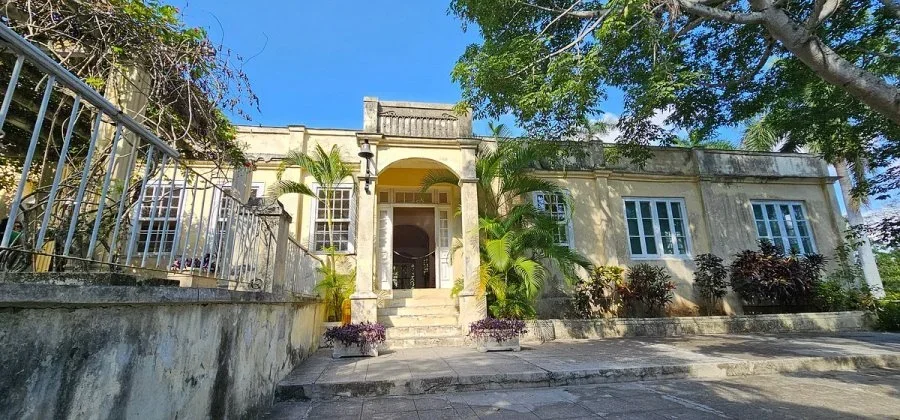
For more than twenty years, from 1939 to 1960, Ernest Hemingway's home was Finca Vigía, the "Lookout Farm", in San Francisco de Paula, a hilltop suburb. Here he produced The Old Man and the Sea, the story of a fisherman from the nearby village of Cojímar, and here he began keeping cats. Today the house serves as a museum and looks as if its owner has just stepped out: thousands of books, hunting trophies from African safaris, the typewriter he used while writing standing up, and bottles on the drinks tray.
Visitors usually look into the rooms through the open windows and doors, which still lets you take in every detail. Stroll through the garden to the tower from which the writer gazed at central Havana, then on to the pool and the Pilar, his 12-metre wooden fishing boat used for chasing marlin. The estate is about 15 kilometres from the centre, so take a taxi, and stop in Cojímar on the way back.
Havana Landmarks: What Else to See While You're in the City
- Callejón de Hamel – an alley in Centro Habana that the artist Salvador González Escalona began covering with murals and sculptures made from old bathtubs and scrap metal in 1990; Afro-Cuban rumba is played here every Sunday.
- Colón Cemetery – a 19th-century necropolis spread over 50 hectares, full of marble tombs, its main gate crowned by statues of Faith, Hope and Charity.
- Fusterlandia – a corner of the fishing village of Jaimanitas on the western edge of the city that the artist José Fuster and his neighbours have covered in bright mosaics, often compared to the work of Gaudí.
- National Fine Arts Museum – two buildings in the centre, one devoted to Cuban painting from the colonial era to today and the other to an international collection.
- Fábrica de Arte Cubano – a gallery, concert venue and club inside an old cooking-oil plant in Vedado, where people come in the evening for exhibitions, films and live music.
- Christ of Havana – a 20-metre statue by the sculptor Jilma Madera, made from 67 blocks of Italian marble and unveiled on Christmas Eve 1958 on the hill across the bay.
- Cojímar – a fishing village east of the centre where Hemingway moored his boat and where an old Spanish watchtower fort still guards the little bay.
- Playas del Este – the beaches in Havana that locals actually use: a 24-kilometre string of sand starting at the eastern outskirts, with Santa María del Mar the closest and most popular.
- Viñales Valley – a karst valley of steep-sided mogotes and tobacco farms about 150 kilometres west, listed by UNESCO for its traditional way of growing tobacco.
- Varadero – Cuba's top beach resort, about 140 kilometres east, set on the narrow Hicacos Peninsula that reaches 20 kilometres out into the sea.
What to See in Havana in 1 Day, 2 Days or 3 Days
Even one day gives you a good feel for the place. In the morning walk through the four squares of Old Havana – Cathedral Square, Plaza de Armas, San Francisco and Plaza Vieja; after lunch see the Capitolio and the Museum of the Revolution, and at sunset stroll along the Prado and the Malecón. On day two, ride a classic convertible through Vedado to Revolution Square, drop by Callejón de Hamel and Coppelia, then cross the bay in the evening to the Morro and La Cabaña for the cannon shot. Give day three to Hemingway's house, Cojímar and the Playas del Este, or to Fusterlandia and the galleries of Vedado. With Havana for a week, add day trips to the Viñales Valley or Varadero and continue to colonial Trinidad on the south coast. Is Havana, Cuba worth visiting? For architecture, music and a slice of 20th-century history that no other city can match, absolutely.
When should you go to Cuba? The most comfortable time is the dry months between November and April, when it is warm, sunny and less humid. From May to October it is hot and heavy downpours are common, and late summer and autumn can bring tropical storms. Can you swim in Havana? The shore along the Malecón is rocky, so people head to the Playas del Este for a swim, while the country's finest beaches are in Varadero. Is Havana safe? Treat it like any big city: hold on to your phone and wallet, avoid empty streets alone late at night and don't leave belongings unattended on the beach. Mobile internet is slow, so download offline maps and a translation app before you leave home, and a power bank and a torch will certainly come in handy.
Plenty of Havana's pleasures cost nothing: wander the colonial squares, the Prado and the Malecón, pop into the cathedral, and take in the murals of Callejón de Hamel and the mosaics of Fusterlandia. Children love the forts with their cannons, the evening shot at La Cabaña, a ride in a coco-taxi or a vintage car and an ice cream at Coppelia. The best-known Cuban dish is ropa vieja, literally "old clothes": shredded beef stewed with tomatoes and peppers, alongside rice and black beans. Classic Havana drinks are the mojito, poured at La Bodeguita del Medio, whose walls are scrawled with visitors' signatures, and the daiquiri, mixed at El Floridita, where a bronze Hemingway leans against the bar. Popular souvenirs are rum, coffee and cigars – Cohiba, Montecristo or Partagás – which are safer to buy in official shops than from people on the street. In the evening, listen to live son and dance salsa in the bars of Old Havana, or catch the Tropicana cabaret, staged under the open sky in a tropical garden since 1939.
Ukraine and Poland have no non-stop flights to Havana; the easiest route is with a connection in Madrid. José Martí International Airport is about 15 kilometres from the centre, and a taxi is the most convenient way into town. Ukrainian citizens need an electronic tourist visa, which is issued online, and shortly before departure every traveller has to complete the D'Viajeros form and show it at check-in and on arrival. Your passport must remain valid for six months or more after entry, and you will also need a return ticket. Bring cash, ideally euros in small notes: cards issued by US banks do not work in Cuba, and some cards from Ukrainian banks can cause problems too, so check yours in advance.
The TurPoisk online travel company's consultants will help you plan your trip to Havana: they will suggest a convenient connecting flight, and our managers can book a hotel for your stay in Old Havana or Vedado. And if after the Cuban capital you fancy some unhurried time on a Caribbean beach, we will find tours to the Dominican Republic – to Punta Cana's white beaches and hotels where everything is included. Our tour search will show options for your dates. Drop us a line, and together we'll map out a route from Havana's squares to the Caribbean Sea.


