
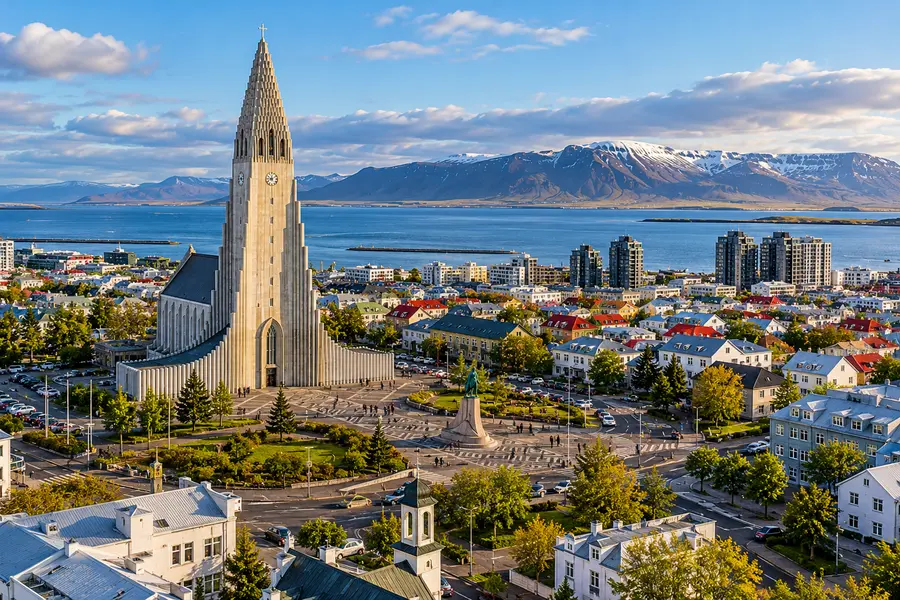
Reykjavík, the capital of Iceland, sits on Faxaflói Bay and is further north than any other capital of an independent country. Its name means "Smoky Bay": according to the sagas, the first settler Ingólfur Arnarson, who made his home here in 874, saw steam from hot springs rising above the shore. That same geothermal water now heats almost every house in the city, its swimming pools and even some of the pavements downtown. Around 140,000 people live in Reykjavík, and with its suburbs the capital area holds two-thirds of the country's population, yet the centre is small and friendly: brightly painted houses clad in corrugated iron, cafés and design shops fit into a handful of streets between the harbour and the hill with the church. If you are wondering what to see in Reykjavík, here are 20 places, from a concrete church that looks like cooled lava to open-air geothermal pools and the geysers of the Golden Circle.
What to see in Reykjavík first
The historic centre, called Miðborg by Icelanders, can be walked in a few hours. From Hallgrímskirkja on its hill, the shopping streets Skólavörðustígur and Laugavegur run downhill; below them lie Tjörnin lake with the City Hall and the square in front of parliament, and beyond those the Old Harbour and Harpa concert hall on the waterfront. Perlan and the thermal pools are a bus or taxi ride away, while the geysers and waterfalls of the Golden Circle need a tour or a hire car, as public transport outside the city is sparse.
1. Hallgrímskirkja
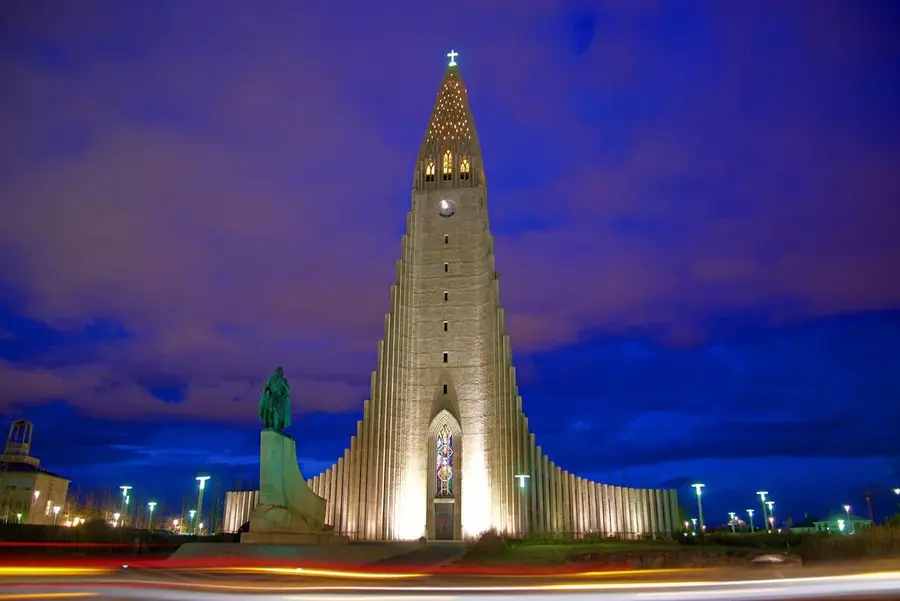
The city's great landmark is visible from almost anywhere: the grey concrete tower of this Lutheran church rises 74.5 metres from the highest hill in the centre. Architect Guðjón Samúelsson drew on the basalt columns that form when lava cools, so the façade echoes Iceland's cliffs and waterfalls. Construction took more than forty years, from 1945 to 1986, and the church is named after Hallgrímur Pétursson, a 17th-century poet known for his Passion Hymns.
Inside is a bright, almost bare nave with tall pointed vaults and a huge organ of more than five thousand pipes. A lift runs up to a viewing platform in the tower, where the colourful roofs, the harbour and the mountains across the bay are laid out before you. Outside the entrance stands a statue of the Viking Leif Erikson, who reached America five centuries before Columbus; the United States gave it to Iceland in 1930.
2. Harpa Concert Hall
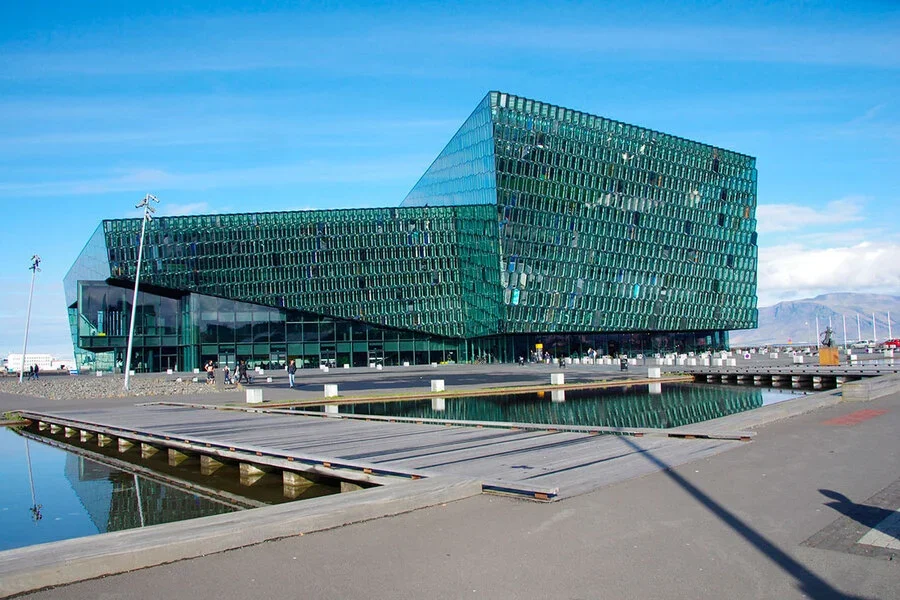
Right on the harbour stands a glass building like a crystal or a block of ice: Harpa, the concert hall and conference centre that opened in 2011. Its façade of hexagonal glass bricks is the work of Olafur Eliasson, the Danish-Icelandic artist, and depending on the weather and the light it shimmers green, amber or grey, glowing with coloured lights after dark.
The national symphony orchestra and the opera company perform here, and the building also hosts jazz festivals and pop concerts, but you can walk in without a ticket. Climb the staircases to the upper floors, where the honeycomb glass frames views of the bay and Mount Esja on the far shore; on a grey day the light inside feels almost theatrical. In 2013 Harpa won the Mies van der Rohe Award, Europe's leading prize for architecture.
3. Sun Voyager
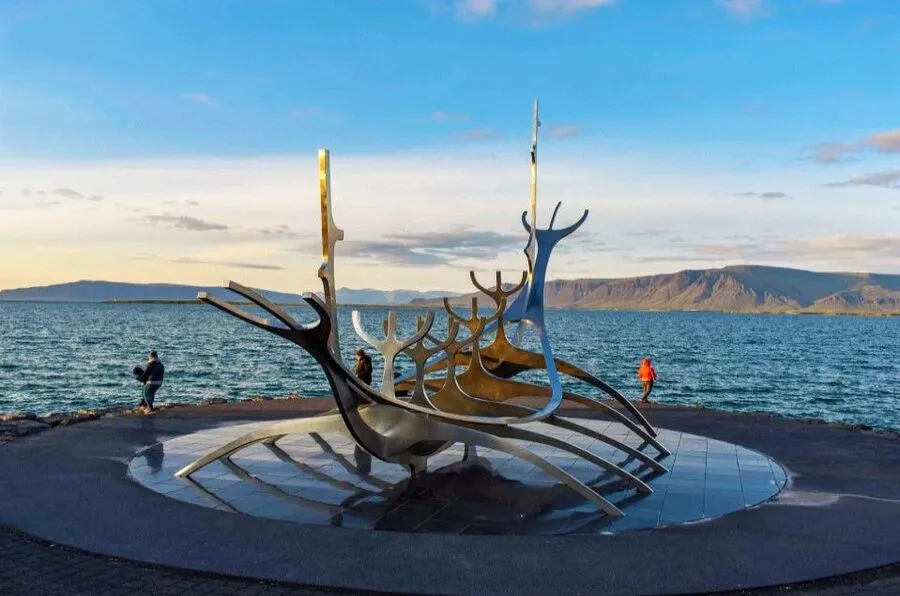
Ten minutes' walk from Harpa, on the Sæbraut seafront, a steel skeleton of a ship points out to sea. Most visitors take it for a Viking longship, but the sculptor, Jón Gunnar Árnason, meant it as a dream boat, an ode to the sun, to light and to the hope of finding new lands. It was installed in 1990, after the artist's death, and quickly became one of the best-known sculptures in the country.
Come at sunrise or sunset, when the polished metal mirrors the sky and snowy Esja gleams behind it. In winter Sun Voyager is one of the spots in the centre where you can try your luck with the northern lights, since there are no tall buildings between the promenade and the sea and the sky is open on every side. A walking and cycling path follows the shore from here.
4. Laugavegur and the Rainbow Street
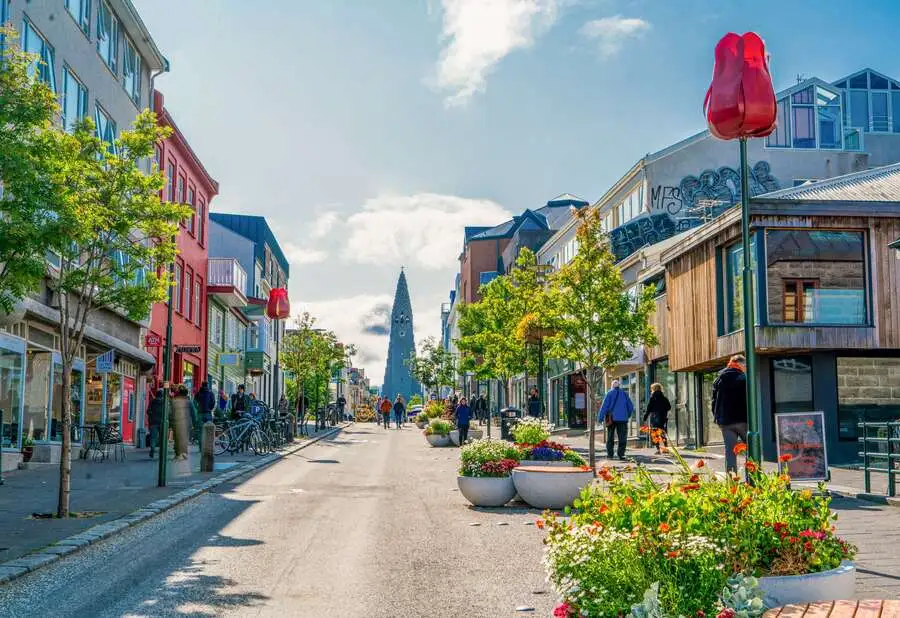
Laugavegur is Reykjavík's main shopping street and one of its oldest: women once carried their washing along it to the hot springs, hence the name, which means "wash road". Today it is lined with Icelandic design shops, sweaters knitted from local sheep's wool, bookshops, bars and cafés, and the houses are painted red, yellow, turquoise and purple, so the street looks festive in even the greyest weather.
From here Skólavörðustígur climbs to Hallgrímskirkja, its paving painted in rainbow stripes. They first appeared for the Pride festival and proved so popular that they stayed for good. This is the city's most photographed spot, so come early before the crowds. Keep an eye on the walls in the side streets too, as Reykjavík is known for large murals by Icelandic and visiting artists.
5. Tjörnin and the City Hall
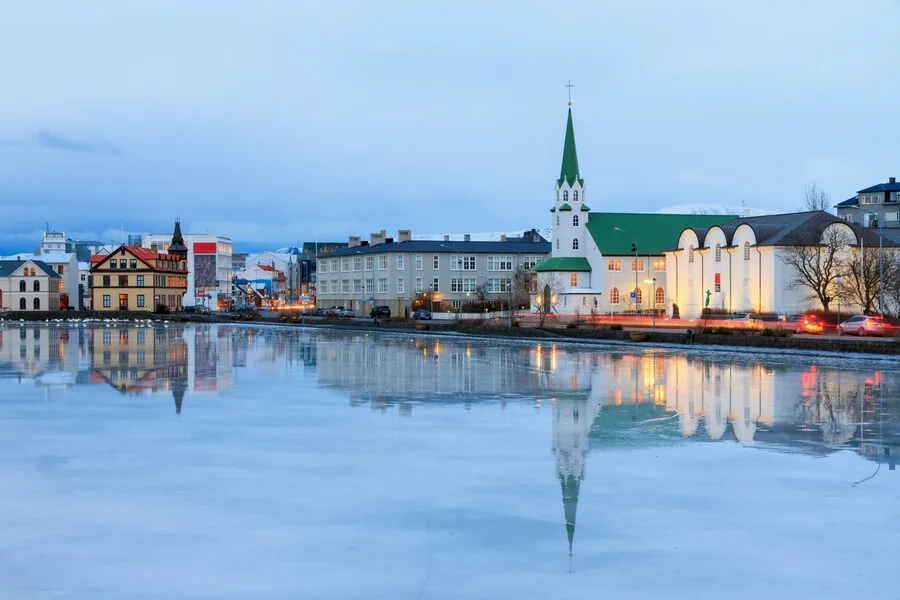
In the middle of the centre lies the small lake that locals simply call Tjörnin, "the Pond". Wooden villas, a church and several embassies line its banks, and ducks, swans, geese and Arctic terns live on the water. In winter part of the lake is kept ice-free with geothermal water so the birds have somewhere to swim, while people skate on the rest.
On the north shore, half over the water, stands the concrete-and-glass City Hall of 1992. Inside, a hall open to everyone holds a giant relief model of Iceland showing every volcano, glacier and fjord, which is useful to study before heading out of town. From here it is a few minutes to Austurvöllur square and the Althing building, and in summer the lakeside fills with picnics and concerts.
6. The Old Harbour
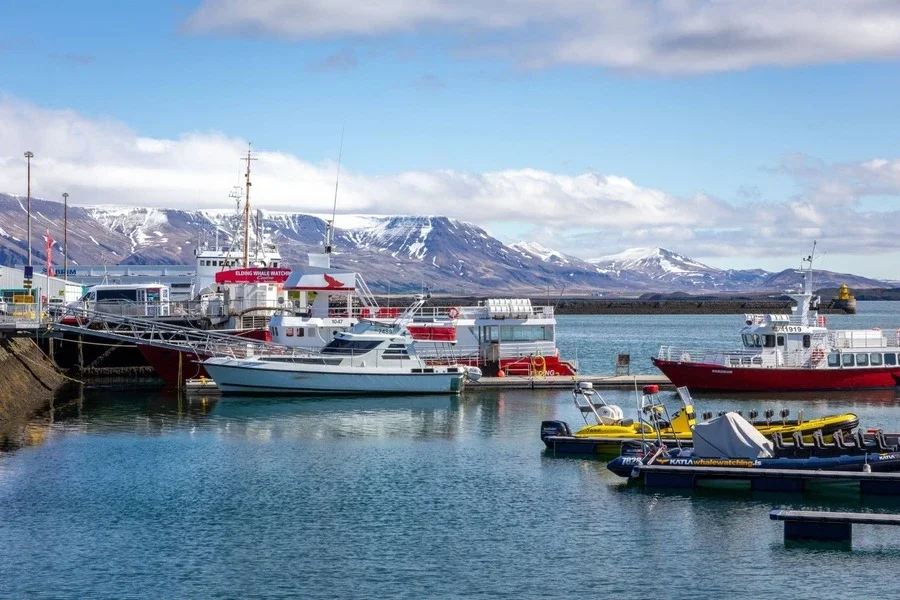
The former fishing sheds of the Old Harbour have become a quarter of restaurants, museums and tour operators heading out to sea. Fish soup and langoustine are on the menus, and boats leave the pier every day for whale and puffin watching: in summer the bay often brings sightings of humpbacks, minke whales and dolphins, while puffins nest on the nearby islands.
In the Grandi district at the western end of the harbour you will find the life-size Whales of Iceland exhibition, the Maritime Museum and the Saga Museum, where wax figures bring the first settlers to life. Afterwards, drop into Kolaportið, the indoor weekend flea market by the harbour, where old sweaters and records share space with dried fish and the infamous fermented shark.
7. Perlan
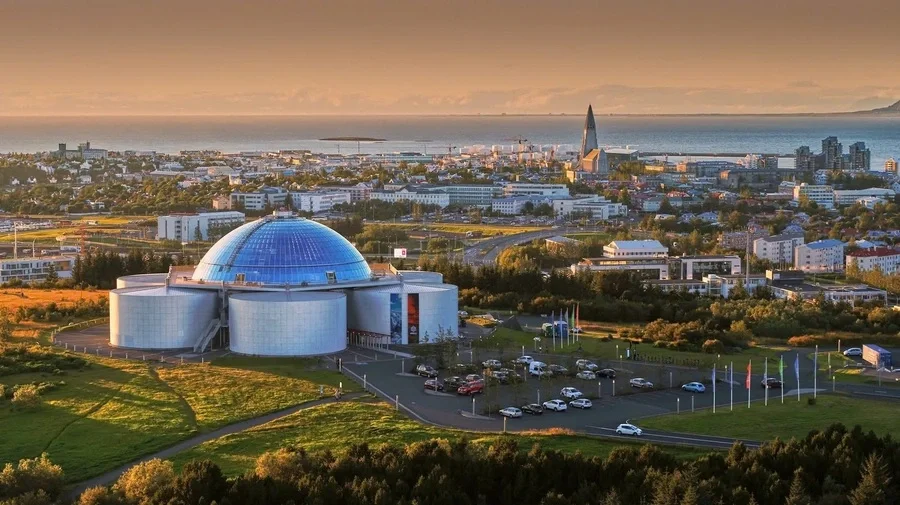
On the wooded hill of Öskjuhlíð, a glass dome sits on six enormous tanks of the hot water that heats the city. This is Perlan, "the Pearl", which opened in 1991 and now houses an interactive museum of Icelandic nature, with exhibitions on volcanoes and glaciers, a real ice cave about a hundred metres long kept below freezing, and a planetarium show about the northern lights.
The best part is the observation deck that circles the dome, with views over all of Reykjavík, the bay, Hallgrímskirkja and the mountains of the Reykjanes peninsula. The hill around Perlan is covered with planted woodland and footpaths, and below it, by the sea, lies the geothermal beach of Nauthólsvík, an easy walk downhill.
8. National Museum of Iceland
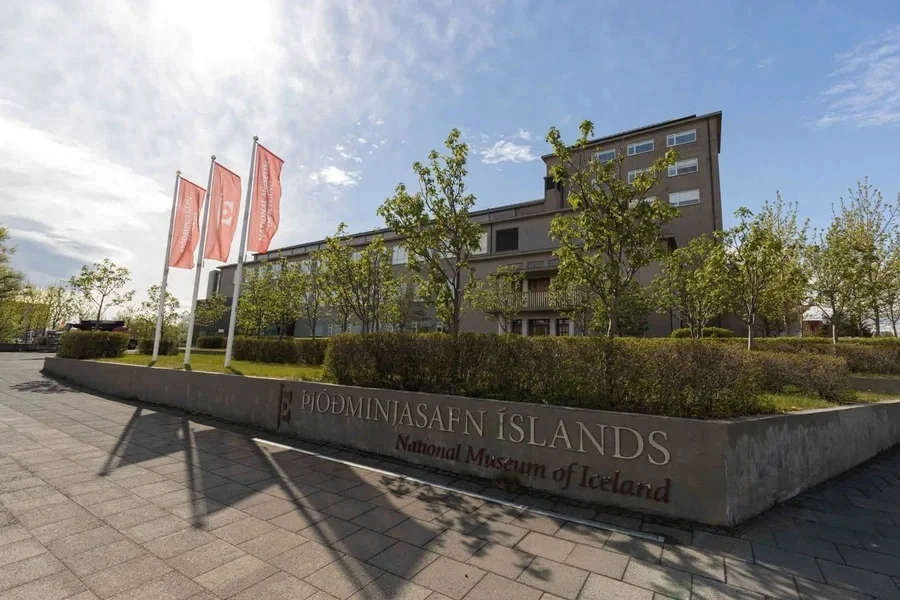
The main exhibition tells the country's story from the arrival of the first Vikings in the 9th century to the present day. On display are swords and jewellery from the settlement era, manuscripts, old drinking horns, folk costumes and everyday objects from the turf houses that Icelanders still lived in at the start of the 20th century.
The prize exhibit is the carved church door from Valþjófsstaður, made around 1200, which shows a knight rescuing a lion from a dragon. The museum is a good choice for a rainy day, and if you want to see where the city began, also visit the Settlement Exhibition 871±2 in the centre, where the remains of a Viking longhouse lie under glass.
9. Thermal pools and Sky Lagoon
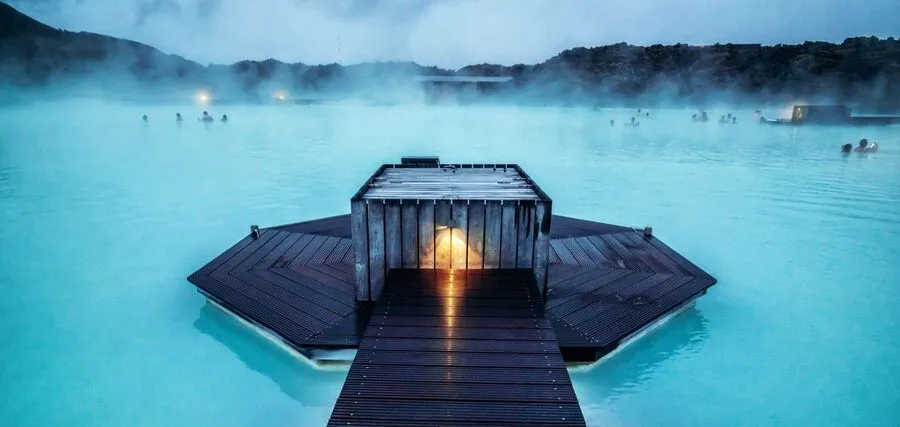
In Iceland the neighbourhood pool works as the village square: people drop in after work to chat with neighbours, soak in the hot tubs and swim outdoors even in a snowstorm. Reykjavík has well over a dozen public geothermal pools, the biggest being Laugardalslaug in the Laugardalur valley. House rules require a thorough shower without a swimsuit before you go in, and the staff take this seriously.
For a soak with a view, head to Sky Lagoon on the Kársnes headland, a few kilometres from the centre. Its warm water seems to spill straight into the ocean, and next to it are a sauna with a panoramic window and a cold plunge. It is at its most beautiful at sunset or in winter, when steam drifts across the water and the sky sometimes flares with the aurora.
10. The Golden Circle
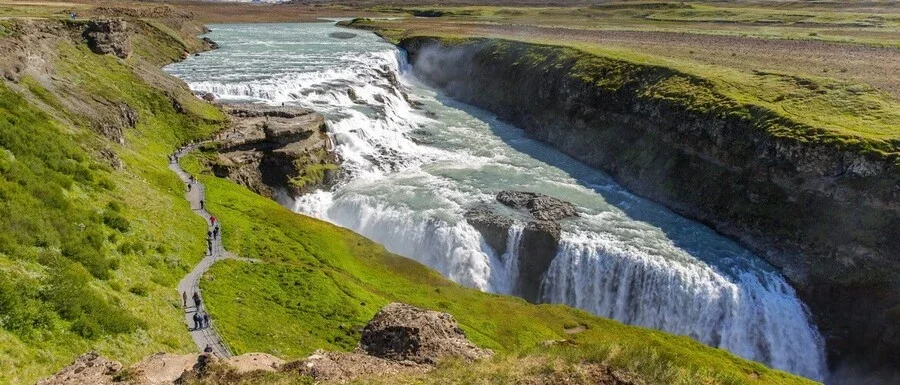
The most popular trip from Reykjavík is a loop of roughly 300 kilometres that packs three natural wonders into one day. In Þingvellir National Park you can walk through the rift where the American and Eurasian tectonic plates pull apart, and it was here in 930 that the Althing, one of the world's oldest parliaments, first met. In the Haukadalur valley hot springs bubble everywhere, and the Strokkur geyser shoots a column of boiling water about twenty metres high every few minutes.
The third stop is Gullfoss, where the Hvítá river drops in two steps into a deep gorge and a rainbow hangs over the spray on sunny days. You can drive the Golden Circle yourself in a hire car or join a guided tour; on the way it is worth stopping at the Kerið crater lake and at the greenhouses where Icelanders grow tomatoes with geothermal heat.
Reykjavík Attractions: What Else to Visit While in the City
- Höfði House — a white wooden house of 1909 on the bay where, in 1986, Ronald Reagan and Mikhail Gorbachev held the summit that marked the beginning of the end of the Cold War.
- The Althing and Austurvöllur — the modest 19th-century stone parliament house on a quiet square with a statue of Jón Sigurðsson, leader of the independence movement.
- Settlement Exhibition 871±2 — an underground museum built around a Viking longhouse. The numbers refer to the year of a volcanic eruption whose ash layer helped date the earliest traces of people in the city.
- Reykjavík Art Museum — three separate buildings: Hafnarhús at the harbour for contemporary art, Kjarvalsstaðir with paintings by the landscape artist Jóhannes Kjarval, and the home and studio of the sculptor Ásmundur Sveinsson.
- Einar Jónsson Museum — Iceland's first art museum, next to Hallgrímskirkja, whose sculpture garden is open to all and filled with bronze figures from Icelandic myth.
- Viðey Island — a green island ten minutes by ferry from the city, where Yoko Ono's Imagine Peace Tower shines every autumn from John Lennon's birthday to the anniversary of his death.
- Grótta Lighthouse — a lighthouse on a tidal islet off the Seltjarnarnes headland, reachable on foot at low tide; in winter people come here to hunt for the aurora away from the city lights.
- Nauthólsvík Beach — a geothermal beach with golden sand, a hot tub and a lagoon where the seawater is warmed, so locals bathe here even in winter.
- Árbær Open Air Museum — an old village of turf houses, a church with a grass roof and small shops, showing how Reykjavík lived before the 20th century.
- Laugardalur Park — a valley with a botanical garden, the city's largest pool and a small family zoo with Icelandic horses, sheep, seals and reindeer.
What to See in Reykjavík in 1, 2 or 3 Days
Is 2 days enough in Reykjavík, or is 3 days better? The city itself can be seen in a day, but few people travel to Iceland just for the capital, so allow two or three days to fit in the Golden Circle and the south coast. If you have only one day, start at Hallgrímskirkja and its tower, walk down the Rainbow Street to Laugavegur, continue to Tjörnin and the City Hall, Austurvöllur and the Settlement Exhibition. Have lunch at the Old Harbour, stroll along the seafront to Harpa and Sun Voyager, and spend the evening in a thermal pool or at Sky Lagoon. On day two, drive the Golden Circle, and give day three to Perlan, the National Museum, a whale-watching trip or the south coast.
When is the best time to visit Reykjavík? Thanks to the Gulf Stream the climate is milder than you might expect, around freezing in winter and 10–15°C in summer, but the weather can change several times a day, so pack a waterproof jacket whatever the season. In June the sun sets close to midnight and the sky never gets dark, while from September to April there is a chance of seeing the northern lights; in December daylight lasts only a few hours. Beyond the capital, Iceland's must-sees include the south coast with the Seljalandsfoss and Skógafoss waterfalls and the black sand of Reynisfjara, the Blue Lagoon on the Reykjanes peninsula, the Jökulsárlón glacier lagoon and, in the north, Akureyri, often called the country's prettiest town.
For free, you can step inside Hallgrímskirkja, Harpa and the City Hall with its model of Iceland, walk the seafront to Sun Voyager, the Rainbow Street and the shores of Tjörnin, and visit the Einar Jónsson sculpture garden, Grótta lighthouse and Nauthólsvík beach. Children will love the ice cave at Perlan, the zoo in Laugardalur, the whales in the bay and any pool with slides and hot tubs. What should you eat? Icelandic lamb soup, skyr, the fish stew plokkfiskur, rye bread baked in the hot ground, and a hot dog "with everything" from the Bæjarins Beztu stand, open since 1937; the brave try fermented shark with a shot of Brennivín. In the evening locals head for the bars on Laugavegur, and in August the city celebrates Culture Night with concerts in the streets.
Ukraine has no direct flights to Iceland, so the most convenient route is via Poland: Wizz Air flies direct from Warsaw, Gdańsk and Katowice, with a flight time of about four hours. Keflavík International Airport is about 50 km from the capital, and the Flybus reaches the centre in 45 minutes. Iceland is part of the Schengen Area, so Ukrainian citizens with a biometric passport need no visa for a short trip. Cards are accepted almost everywhere, even at hot-dog stands, and the tap water is excellent.
When Reykjavík's days are at their shortest, Icelanders themselves fly south for the sun, most often to Spain's Canary Islands and above all to Tenerife, long their favourite winter escape. The team at the TurPoisk online travel agency can help you combine both trips: book a hotel in central Reykjavík for the season of white nights or northern lights, and for a warm holiday find tours to Spain, whether to Tenerife with its eternal spring or, in summer, to Mallorca or the Costa Brava. Use our tour search to see options for your dates, check last-minute deals, and our consultants will tell you when to fly for the aurora and when for a tan.


