
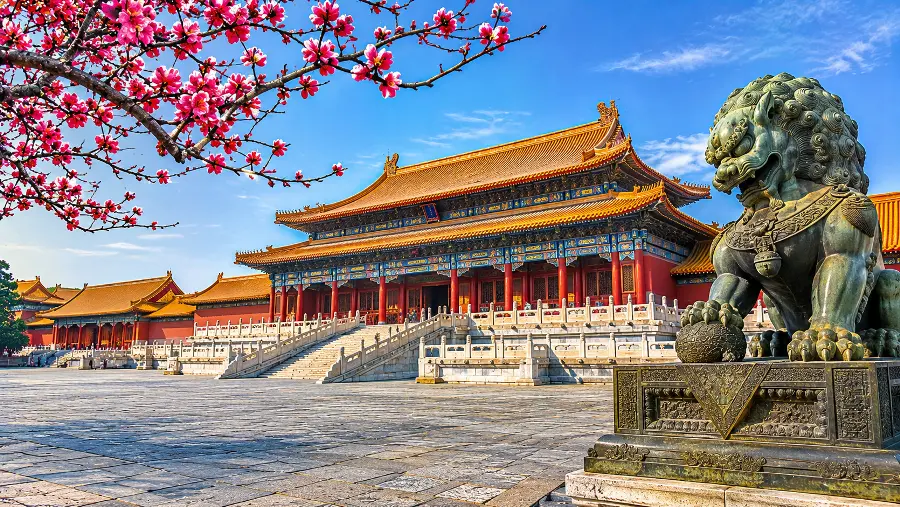
China's capital, Beijing, home to more than twenty million people, wraps a modern metropolis around the walls of imperial palaces. Its name means "Northern Capital", given by the Ming emperors who moved their court here from Nanjing in the south in 1421. Long before that, the Mongol ruler Kublai Khan had his seat on this spot, a city called Khanbaliq that Marco Polo wrote about. Over six centuries, emperors filled Beijing with palaces, temples and gardens now protected by UNESCO, and next to them rose futuristic towers and the stadiums of two Olympic Games. Between the broad avenues the hutongs still survive, narrow lanes of single-storey courtyard homes where neighbours sit on their doorsteps over a game of mahjong. Here are twenty places worth your time, covering what to see in Beijing and beyond, from the Forbidden City all the way to the Great Wall.
What to See in Beijing First
The old city is laid out along a single north–south axis, running from Qianmen Gate through Tiananmen Square and the Forbidden City to Jingshan hill and the Drum Tower. Ring roads loop outwards around the centre, and the distances are far too great to cover on foot. The answer is the metro, one of the biggest on the planet, with signs and announcements in English, and it beats sitting in traffic in a taxi by a wide margin. Every metro station and every major sight has a security scanner and bag check at the entrance, so keep your passport with you at all times.
1. The Forbidden City
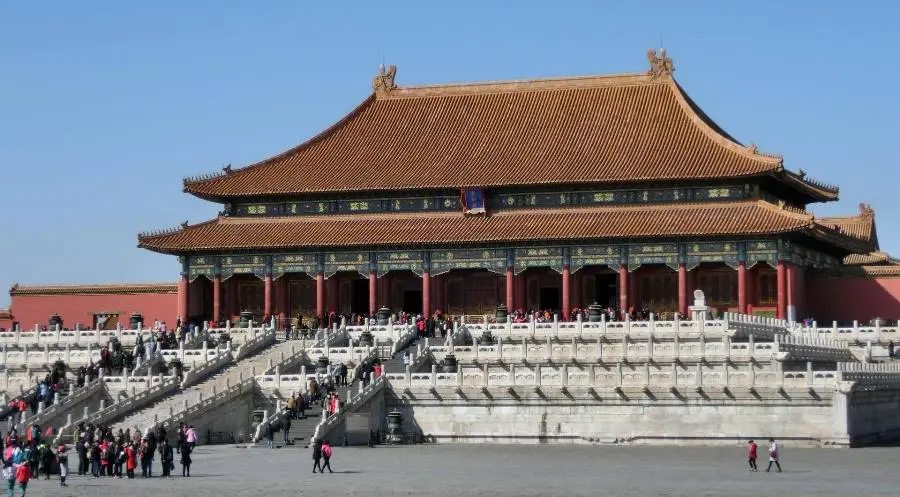
For five hundred years, from 1420 until 1924, two dozen rulers of the Ming and Qing houses lived behind these red walls, and ordinary people who tried to enter risked their lives. No larger palace complex survives anywhere: almost a thousand buildings under yellow-glazed tiles, inner courtyards, marble bridges and staircases. Legend puts the number of rooms at 9,999, one short of the palace of Heaven, since an earthly ruler dared not match the gods.
Today it is the Palace Museum, and you should plan on at least a morning or an afternoon. You enter from the south through the Meridian Gate, pass the throne halls of Supreme Harmony, continue into the living quarters and the emperor's garden, and leave from the north side, right across from Jingshan Park. Daily ticket numbers are capped, so book ahead, and come straight after opening time when the crowds are thinnest.
2. Tiananmen Square
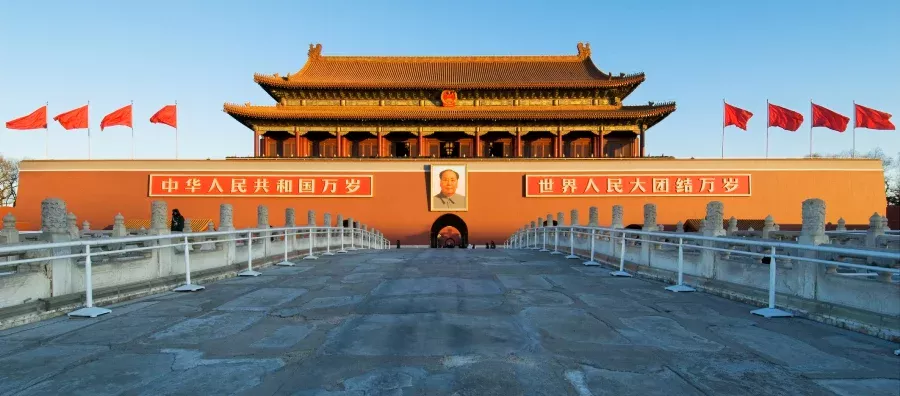
Few public squares on earth rival this one in size, and it was here, on 1 October 1949, that Mao Zedong declared the People's Republic. Tiananmen gate, its name meaning 'heavenly peace', rises along the northern edge with the giant portrait of Mao, while an obelisk honouring the people's heroes stands in the middle. On the western side stands the parliament building known as the Great Hall, to the east China's National Museum, the world's largest museum by single-building floor area, and to the south Mao's mausoleum.
The most solemn moment is the flag-raising at dawn, when locals arrive while it is still dark, and the lowering of the flag at sunset. Expect ID and bag checks on the approach, often with queues, so build in extra time. Inside the museum, the ancient China galleries with their bronzes, jade and porcelain are the ones not to miss.
3. Temple of Heaven
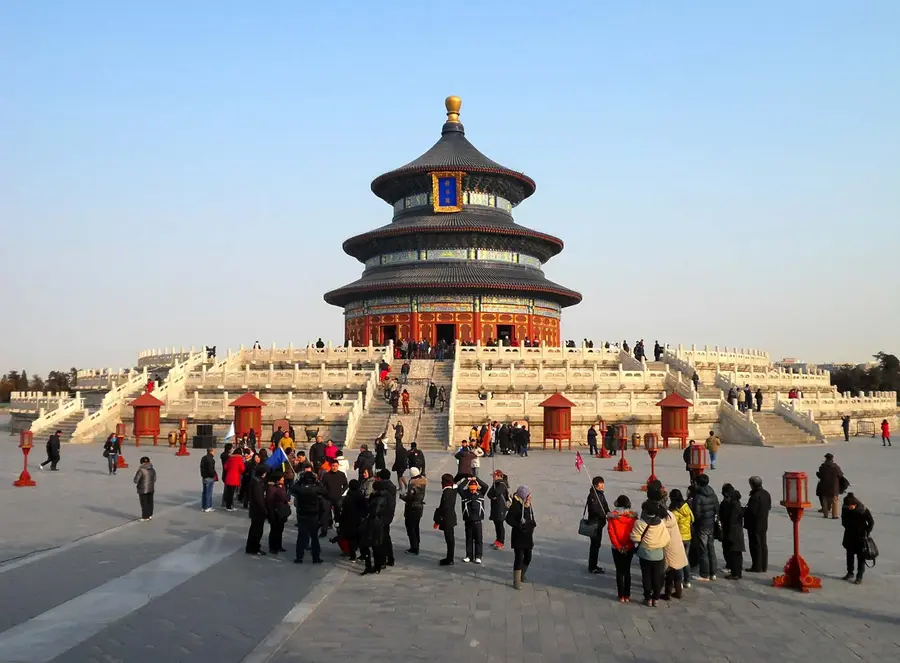
Emperors came here every year to ask the heavens for plentiful crops, and the whole complex is designed as a model of the universe: square bases stand for the earth, round buildings for the sky. The centrepiece is the round Hall of Prayer, crowned by a triple blue roof and built of timber without a single nail. Further south are the Echo Wall, where a whisper carries round to the far side, and the three-tiered marble Circular Mound Altar.
The temple sits in a huge park of ancient cypresses that turns into a giant social club every morning. Retirees practise tai chi, dance, sing, play cards and Chinese chess, or brush characters onto the paving stones with water. Coming early is the best possible way to watch ordinary Beijing life.
4. Summer Palace
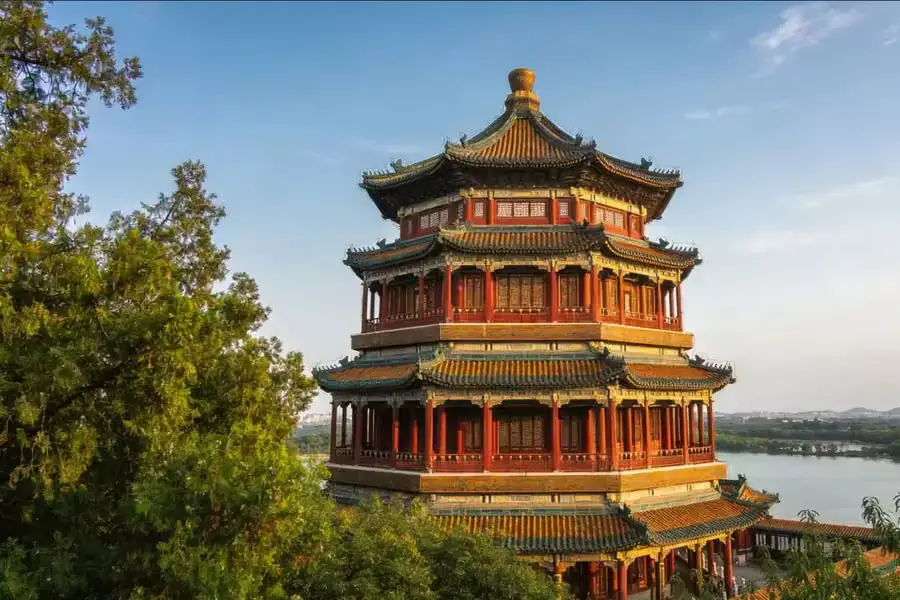
The emperors' country retreat in the north-west of the city spreads over nearly three square kilometres, about three quarters of it taken up by Kunming Lake. Longevity Hill rises above the water, topped with temples and the Pagoda of Buddhist Fragrance, and a bridge of seventeen arches leads out to an island. Empress Dowager Cixi adored the place and, so the story goes, spent money meant for the navy on rebuilding it.
Along the shore runs the Long Corridor, a covered walkway whose ceiling and beams carry thousands of painted scenes from legends and novels. Near its far end stands the Marble Boat, a pavilion shaped like a ship that never set sail. In summer people row across the lake, and in winter, once it freezes, they skate on it.
5. The Great Wall
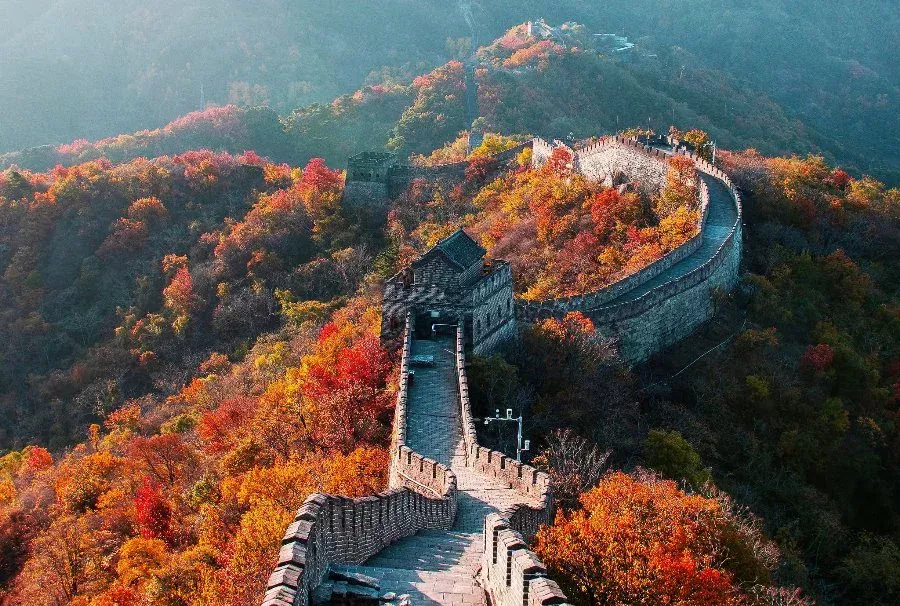
Beijing's most famous stretches of the Great Wall lie within a day trip of the city. The closest and busiest is Badaling, around 80 km north-west, built in 1505; a train goes there, but so do most tour groups. Mutianyu is calmer and more scenic: 22 watchtowers crowd a stretch of just over two kilometres, a cable car lifts you up, and a toboggan run brings you back down.
Keen hikers head for Jinshanling across the border in Hebei province, where parts of the wall are restored and others look much as the Ming builders left them. Set off as early as possible to beat the crowds, and wear sturdy shoes, as the steps are steep and uneven. We tell the story of the structure itself in a separate article about China's Great Wall.
6. Lama Temple
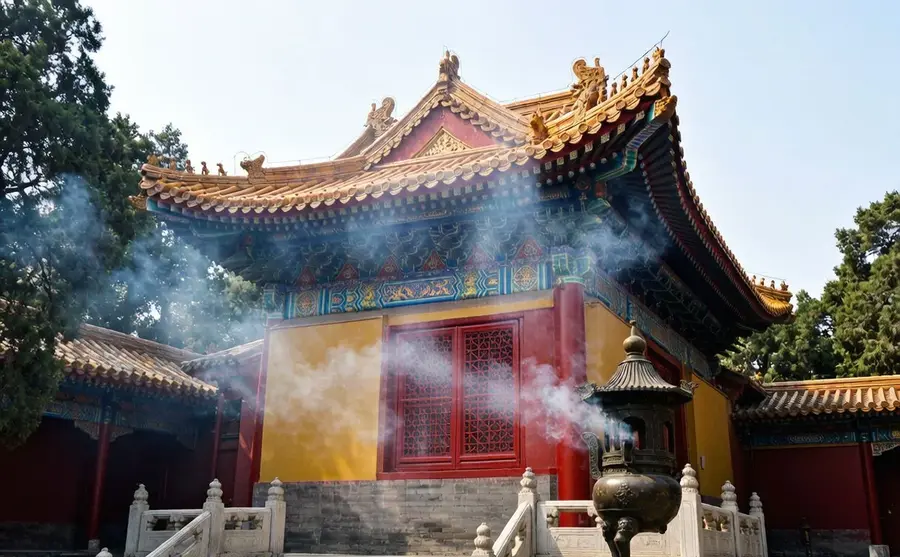
Beijing's largest Tibetan Buddhist monastery, belonging to the Gelug school, began life as the residence of a prince who later became the Yongzheng Emperor. Once he took the throne, the mansion was turned into a temple, and it now blends Chinese and Tibetan styles, with red walls, golden roofs, drums and rows of prayer wheels.
Incense smoke drifts through the courtyards as worshippers light their sticks and bow to all four directions. The last hall holds a sandalwood Maitreya Buddha cut from a single trunk, rising 18 metres above the floor with 8 more hidden below. The Temple of Confucius and the Imperial Academy are just across the road, making it simple to combine all three.
7. Hutongs and the Shichahai Lakes
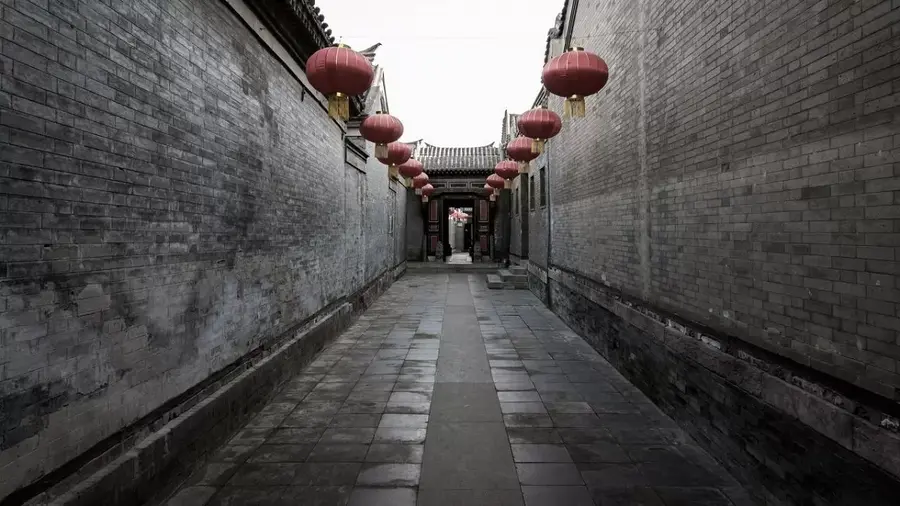
Hutongs are the lanes that run between siheyuan, traditional homes with blank grey outer walls wrapped around an inner courtyard. The whole old city was once built this way, and although many neighbourhoods were demolished, plenty survive in the districts beyond the palace's northern wall. The best known is Nanluoguxiang, an alley of roughly 800 metres dating from the Yuan dynasty and now lined with cafés, small shops and street snacks, though the side lanes are where everyday life carries on.
Close by lie the three Shichahai lakes, a name that means roughly 'sea of ten temples'. The liveliest is Houhai, with bars and live music along the bank, and in winter people skate and ride chair sledges on the ice. From there it is a short walk to the old Bell and Drum Towers, which once announced the hours to the city, and to Prince Gong's Mansion.
8. Jingshan and Beihai Parks
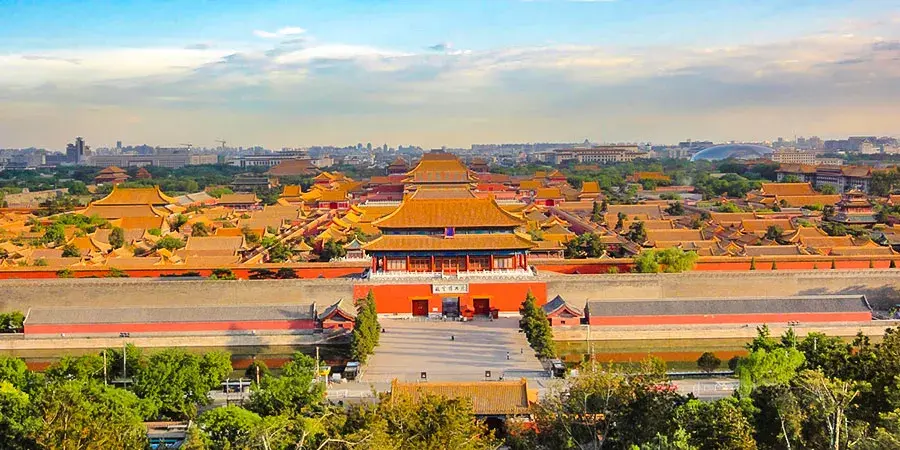
Jingshan hill was piled up from the earth dug out for the moat around the palace, and the pavilion on its summit gives the finest view over the palace's sea of golden roofs. On one of its slopes the final Ming ruler took his own life in 1644 as rebels broke into the capital. Climb it straight after your palace visit, since the exit is directly opposite.
West of the hill lies Beihai, a former imperial garden where a lake fills more than half the grounds. On Qiongdao island stands the White Dagoba, a stupa you can spot from many corners of the old city. People hire boats, listen to street musicians and admire the Nine-Dragon Wall, faced in brightly coloured glazed tiles.
9. Olympic Park
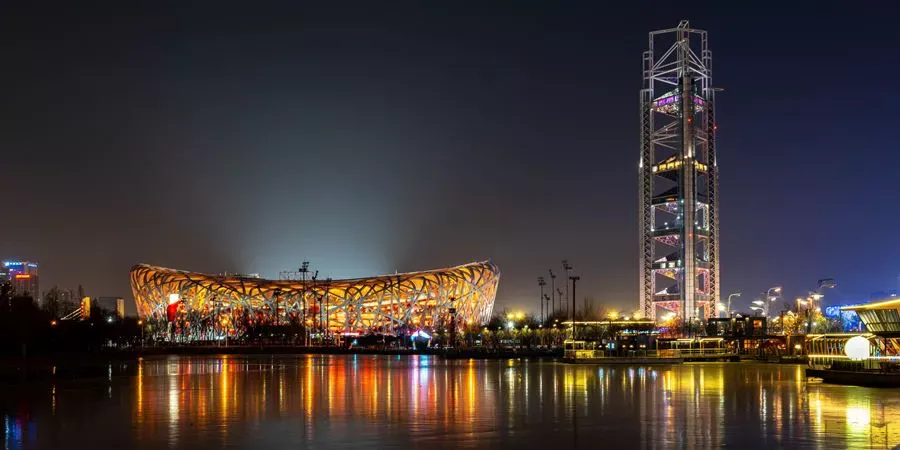
No other city has staged both a Summer and a Winter Olympics: Beijing did so in 2008 and 2022. The main arena, the National Stadium, earned the nickname Bird's Nest for its tangle of steel beams and seats 80,000 spectators. Beside it stands the Water Cube, the swimming venue with a façade like soap bubbles, which hosted curling during the Winter Games.
The park looks most striking after dark, when the Nest glows red and the Cube glows blue. Families stroll the wide avenues, fly kites and roller-skate, and north of the stadiums a large forest park with a lake stretches away. The metro gets you there easily, and the visit pairs well with the 798 Art Zone.
10. 798 Art Zone
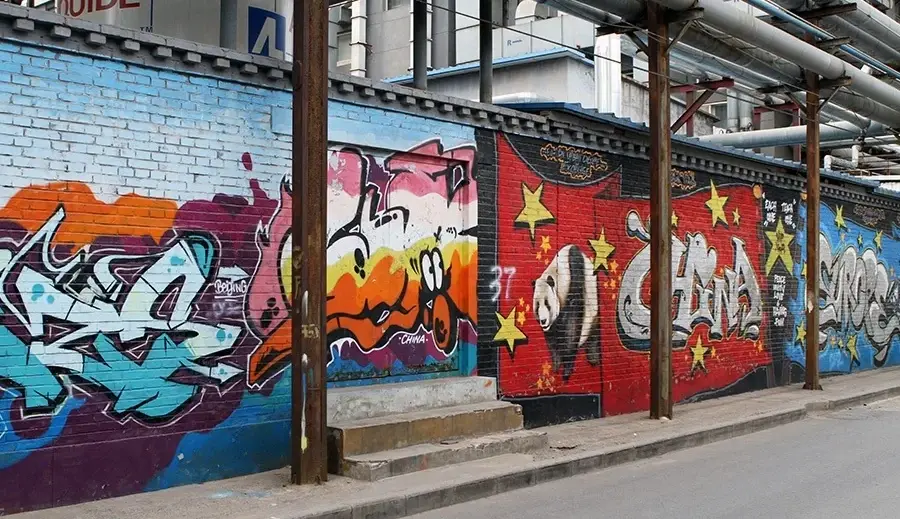
This district in the north-east occupies the halls of a former military factory, built in the 1950s with help from East German engineers. Tall workshops with saw-tooth roofs and red slogans on the walls now frame galleries, design studios, bookshops and cafés, and the quarter has become the centre of contemporary art in China.
It hosts exhibitions and design and film festivals, and large sculptures in the streets make favourite photo props. Most galleries charge no admission, so give the district a few hours and simply drift from one space to the next, stopping for coffee along the way.
Beijing Landmarks: What Else to See While You're in the City
- Yuanmingyuan — the shattered Old Summer Palace, whose European-style pavilions were burned by British and French troops in 1860.
- Temple of Confucius — China's second-largest Confucian temple, founded in 1302, with 198 steles carved with the names of over 51,000 scholars.
- Prince Gong's Mansion — a courtyard estate with gardens by the Shichahai lakes, built for the official Heshen, remembered as China's most notorious grafter.
- Qianmen and Dashilan — the old gate south of the square and the shopping street behind it, home to historic pharmacies and silk and tea shops.
- Wangfujing — the main shopping street, named after the princes' mansions and a sweet-water well that once stood here.
- Liulichang — a street of shops selling brushes, ink, calligraphy paper and antiques, where a workshop once produced glazed roof tiles for imperial buildings.
- Ming Tombs — the valley where thirteen Ming emperors are buried, approached along the Sacred Way flanked by stone animals and warriors.
- Xiangshan Park — the Fragrant Hills on the city's western edge, which blaze red with maples and smoke trees in autumn.
- Beijing Zoo — China's oldest zoo, founded in 1906, whose star residents are the giant pandas.
- National Centre for the Performing Arts — a glass half-egg housing the opera, in a lake beside Tiananmen Square, known locally simply as the Egg.
What to See in Beijing in 1 Day, 2 Days or 3 Days
Three days cover the essentials. Is 3 days enough to visit Beijing with trips out of town? Not quite, so allow four or five. Day one: start early on Tiananmen Square, move on to the Forbidden City, followed by the climb up Jingshan and a walk through Beihai, with Wangfujing or Qianmen in the evening. Give day two entirely to the Great Wall, leaving for Mutianyu at dawn and returning by dusk. Begin day three among the tai chi regulars in the cypress grounds around the Temple of Heaven, then visit Yonghegong and the Confucius temple, and finish in the hutongs and bars of Houhai. With a fourth and fifth day, add the Summer Palace together with the ruins of Yuanmingyuan, the Olympic Park and the 798 Art Zone, and with children the Universal Beijing Resort on the eastern outskirts. What is Beijing most famous for? The Forbidden City, the Great Wall and Peking duck, and none of them should be skipped.
Beijing is at its best in April and May, then again September through late October, when the air is dry, the sun shines and the parks turn gold and crimson. Summer is hot and sticky, with downpours in July, while winter is cold and dry, with frost and biting winds, though crowds are thinner and the frozen lakes open for skating. In spring, Gobi sandstorms occasionally sweep over the city, so a face mask helps on those days. Avoid the Golden Week around National Day at the start of October and Chinese New Year, when every sight is packed. People speak Chinese and little English, so a translation app is essential. Cash is fading fast: locals pay with Alipay and WeChat Pay, both of which now accept foreign cards. Google services and most Western social networks are blocked in China, so sort out how you will stay connected before you go.
Free things to do in Beijing include strolling Tiananmen Square, the hutongs, the shores of Houhai, Wangfujing and Qianmen streets, and most of the galleries in the 798 Art Zone. Families will enjoy the Universal Beijing Resort with its Kung Fu Panda and Harry Potter areas, the pandas at the zoo, the Olympic Park and Mutianyu, where you ride a toboggan down from the wall. The city's signature dish is Peking duck, roasted until the skin crackles, carved at the table and rolled into thin pancakes with slivers of cucumber and scallion and a dab of sweet bean paste. Also try jiaozi dumplings with all sorts of fillings, zhajiangmian noodles topped with a fermented bean sauce, and tanghulu, sugar-glazed hawthorn berries on a stick. After dark, see a Peking opera with its vivid face paint or an acrobatics and kung fu show, then unwind in a teahouse.
Travelling from Ukraine, most people go through Poland, since Air China runs a direct service between Warsaw and Beijing that takes nine to ten hours. The city has two international airports: Capital Airport lies 32 km to the north-east, and starfish-shaped Daxing 46 km south of downtown, with express trains to both. Holders of Ukrainian passports must get a visa for Beijing from a Chinese embassy or consulate in the country where they are staying, with six or more months of validity remaining on the passport. On top of that, complete China's online arrival form in the 24 hours before landing and save the QR code for passport control.
If Beijing is a dream for later but you want China and the sea right now, consider the tropical island of Hainan. Holiday planners from the TurPoisk travel company can find tours to Hainan with beach hotels in Sanya, which charter flights reach from Prague. Ukrainian citizens flying straight into Sanya need no visa, only the same electronic arrival card completed within 24 hours of arrival. Our managers will also help with Beijing and book a hotel by the old city or near a metro stop. Get in touch, and we'll sketch a route linking the imperial palaces with Hainan's beaches.


