

The Sistine Chapel is a historic building in the Vatican, built between 1473 and 1481 by the architect Giorgio de Dolci and named after Pope Sixtus IV. Currently, it serves for conclaves, including the election of a new pontiff. In addition, the chapel is a unique museum of Renaissance art, superbly famous for its frescoes created by the great artist Michelangelo Buonarroti.
Sistine Chapel Ceiling: Michelangelo's Masterpiece
In 1508, Pope Julius II entrusted the young sculptor Michelangelo with a difficult mission - to create a fresco painting of the vault of the Sistine Chapel in the shortest possible time. At that time, Michelangelo was only 33 years old, and he had no previous experience with wall painting.
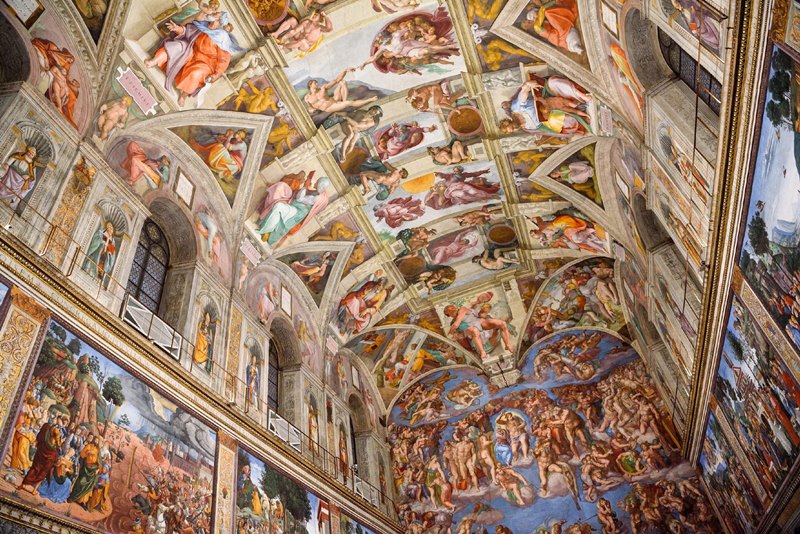
To begin his work, Michelangelo Buonarroti built a stage near the ceiling. Changing positions from lying down to standing, with his neck thrown over, he recreated the frescoes. The paintings under the vault of the Sistine Chapel represent nine scenes from the Book of Genesis, divided into three groups:
I – Creation of the world;
II – The creation of Adam and Eve, their fall and expulsion from Paradise;
III – Trials that befell all humanity .
In just 4 years, Michelangelo completed his magnificent works, and in 1512 the fresco painting under the ceiling of the chapel was completed.
Michelangelo Buonarroti's frescoes in the Sistine Chapel are masterfully executed works of art.
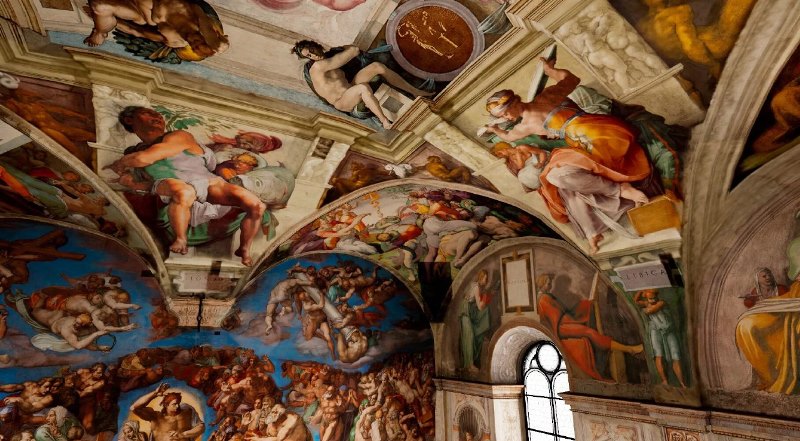
The first composition that embodied the global catastrophe was the work called “The Flood.” In the center of the chapel's ceiling is the famous fresco "The Creation of Adam", where God touches the hand of the first man, giving him life. This work is considered one of the highest achievements in the history of world painting. Another theme that occupied a central place in Michelangelo’s work was “The Creation of Eve,” and the final part was “The Fall and Expulsion from Paradise.”
A quarter of a century after Michelangelo Buonarroti donated his works under the arches of the church in Rome, the new Pope Paul III entrusted him with a new great task - to paint the walls of the Sistine Chapel. This is how the magnificent fresco “The Last Judgment” appeared, created between 1537 and 1541.
The peculiarity of the technique for creating this gigantic painting was that the entire fresco was divided into fragments that filled the space of the Sistine Chapel - with a total area of 450 square meters. At the top of the work, Michelangelo depicted angels, in the center - Jesus and the Virgin Mary, surrounded by the blessed. Particular attention is drawn to the lower tier, where the End of Times and the Last Judgment are presented - sinners are sent to Hell, and the righteous are raised to Paradise.
Interesting facts about the Sistine Chapel
- Externally, the Sistine Chapel is an inconspicuous 15th century church, looking like a typical fortification.
- In 1940, the Lascaux cave with ancient cave paintings was discovered in southwestern France, and it was soon called the “Sistine Chapel of primitive painting.” The stones depict scenes from the Late Paleolithic era, and the age of the images is estimated at about 20 thousand years.
- Before Michelangelo began his work, the Sistine Chapel was decorated by such outstanding masters as Botticelli, Perugino, Ghirlandaio and Cosimo Rosselli. 27 years after the restoration of the paintings of his predecessors, the young artist had to create his own frescoes.
- It is known that the young artist Michelangelo reluctantly began to paint the Sistine Chapel. This is evidenced by lines from a poem he wrote: “I had to pay for my work with a goiter, an illness... My chin is built into my stomach. My chest is like a harpy’s; my skull is supported by a hump, and my beard stands on end, and paint is dripping on my face ...".
- The medical field has coined the term “Sistine Chapel Syndrome” to describe loss of consciousness when the head is suddenly thrown back. Viewing a masterpiece from the ceiling requires tilting the head, which can lead to compression of the vertebral arteries and disruption of blood circulation in the brain, causing loss of consciousness in a person.
- In The Secrets of the Sistine Chapel, Benjamin Blech and Roy Doliner provide their interpretation of Michelangelo Buonarroti's frescoes and reveal the true meaning of the images.


