
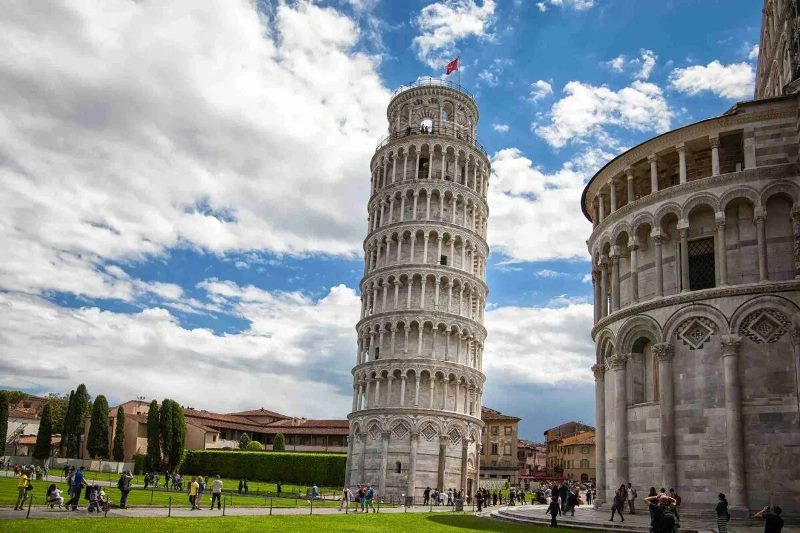
The Leaning Tower of Pisa, one of the most famous architectural monuments in Italy, is part of a larger story. The construction of this tower, which is the belfry of the city's Cathedral of Santa Maria Assunta, took almost two centuries, starting in 1173 and ending in 1360. Interestingly, few people know that it began its journey as an ordinary bell tower. However, its inclination, acquired by accident, gave it uniqueness and attracted the attention of tourists from all over the world. Without this tilt, the Leaning Tower of Pisa would probably not attract so many enthusiastic visitors.
Why is the Leaning Tower of Pisa tilted?
The reason for the leaning of the Leaning Tower of Pisa lies in the peculiarities of the terrain on which it was built. The base of the tower rests on depleted and clayey soils, which caused its original orientation to the south during the initial stages of construction. The foundation of the tower is only three meters high, and together with the unstable soil, this became the source of its tilt. In the ten years since its construction, the foundation has moved as much as 30-40 cm.
For eight centuries, the Leaning Tower of Pisa continued to deviate from the vertical, and its inclination increased by more than five meters. Every year the tower continues to bend by 1 mm. The difference in levels between the southern and northern parts of the foundation exceeds two meters. The initial design of the Leaning Tower of Pisa was already flawed, so the statement that the architects specifically intended such a slope is not true. However, as it turned out, this mistake turned into a landmark of this landmark.
Why doesn't the Leaning Tower of Pisa fall?
The point is that her center of gravity was skillfully placed above the foundation. This result was achieved thanks to the efforts of builders who tried to correct the tilt of the tower for many centuries. Its angle of inclination changes periodically due to the influence of factors such as soil displacement, groundwater level and the intervention of builders.
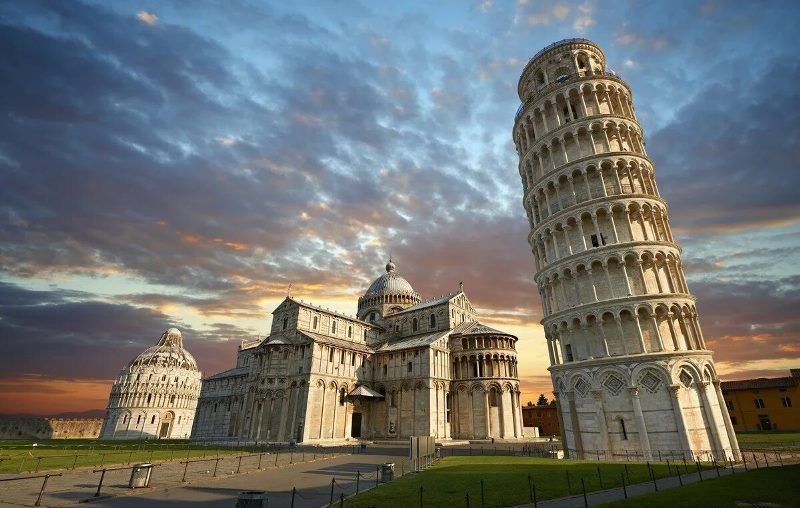
The period from 2002 to 2010, during which restoration was carried out, is worth noting among the latest measures to preserve the Leaning Tower of Pisa. This process caused the inclination angle to decrease from 5 degrees 30 minutes to 3 degrees 54 minutes.
History of the Leaning Tower of Pisa
The construction of the Leaning Tower of Pisa began on August 9, 1173, a century after the completion of the Pisa Cathedral. Although some sources attribute the design to the architect Bonnano Pisano, the exact authorship remains unknown. Even at the beginning of construction, it was discovered that the clay soil under the base of the tower began to sink, and construction was stopped for a year. By 1178, three floors of the tower had already been built, but at that time it had already begun to tilt to the south. As a result of this tilt, construction was stopped for almost a hundred years.
In 1272, when the leaning of the Leaning Tower of Pisa reached 50 cm, work on its construction resumed under the leadership of Giovanni di Simone. By 1284, the height of the tower was 48 meters, and six floors with loggias-galleries were built. Despite Giovanni di Simone's efforts to straighten the axis of the building, the leaning of the Leaning Tower still remained. At that time, the tower already had a roll of 90 cm from the vertical, and the construction was temporarily stopped.
In 1319, the 7th floor of the bell tower was completed, and in 1360 - the last, 8th floor (bell tower). At that moment, the slope was almost 1.5 meters.
Despite the fact that the construction of the Leaning Tower of Pisa was completed and lasted as long as 187 years, in subsequent periods its stability, as before, raised questions. In the middle of the 20th century, a special commission was created to prevent the destruction of this significant landmark. And to this day, restoration work is ongoing, including underground efforts to strengthen the foundation and keep the leaning Leaning Tower of Pisa stable.
The Leaning Tower of Pisa inside: let's look at the Interior
The interior decoration of the tower impresses with its magnificence. Galleries connected by elegant arches provide a unique atmosphere. Bas-reliefs carved into the walls depicting mythical creatures decorate the spacious hall. A majestic spiral staircase leads to the top, where there is a belfry with arches for seven bells. Amazingly, all of these bells are still in working order and can be heard ringing every day at noon and before every mass in the Cathedral of Santa Maria Assunta.
The architectural style of the Leaning Tower can be described as Romano-Pisanian. Its walls are made of solid stone and decorated with light gray and white marble. A special feature of the tower is the presence of a hall with an open ceiling, which allows visitors, coming at night, to enjoy the view of the starry sky over the city of Pisa.
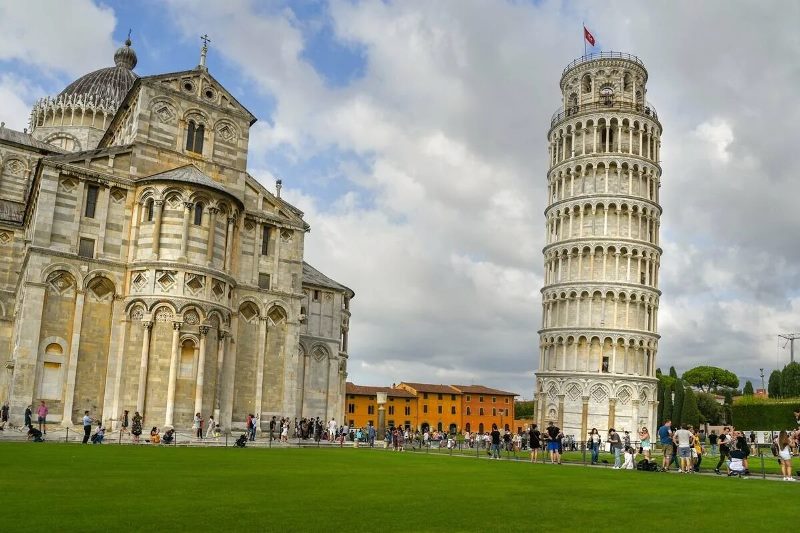
To get to the top of the Leaning Tower of Pisa, you need to climb 294 steps made of natural marble. As you climb to the top, the width of the stairs decreases, and at the top level the steps become only 40 cm wide. Due to this, tourists move up and down in line, and special personnel are on site to control and regulate traffic.
Looking through the observation windows, inside the inner walls, you can see that the Leaning Tower of Pisa is empty inside. Starting from the fifth level, you can go to the observation decks, which are equipped with fencing nets. There are no nets on the eighth floor, and from this height there is an impressive view of the surrounding area, including the Field of Miracles.
Studies of Galileo Galilei
Galileo Galilei, an outstanding physicist and philosopher born in the city of Pisa, conducted a famous experiment that became key in the history of science. His goal was to test whether the mass of an object affects the speed of its fall. At that time, there was a general belief that heavy objects fall faster than light ones.
To conduct this experiment, Galileo climbed to the top of the Leaning Tower of Pisa. From this height, he simultaneously released a cannonball weighing 80 kilograms and a musket ball weighing only 200 grams. This experiment shed light on an important physical problem and proved that the mass of a falling object does not affect its speed of fall. This discovery was of great importance for the development of science and changed the idea of the laws of gravity.
Interesting information, amazing facts about the Leaning Tower of Pisa
- 2018 marked the 845th anniversary of its foundation. The height of the Leaning Tower of Pisa is 56.7 meters, and it has only eight floors. The weight of the tower reaches 14.7 tons.
- There are approximately 300 "leaning" towers in the world that deviate slightly from their vertical axis. Among the most famous are Big Ben, the clock tower in Izmir and the towers in Bologna.
- Each of the bells inside the tower has its own name and unique weight. The most powerful of them weighs 3.5 tons, and the oldest bell is Pasquereccia, which dates back to the 13th century.
- The term "Pisa tower" has become a synonym for any unstable vertical structure.
- Tens of millions of euros have already been spent on efforts to save the Leaning Tower of Pisa.
- A water tower was erected in the American city of Niles, which is an exact copy of the Leaning Tower of Pisa, but half the size.
- The flag flying on the tower is associated with the 15th century Republic of Pisa.


