
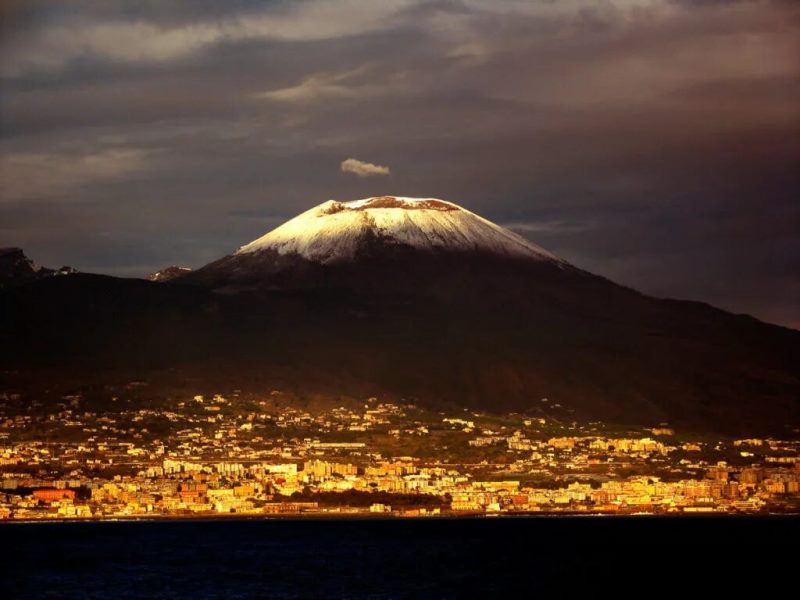
When you hear the word "volcano", the first thing that often comes to mind is Vesuvius. And if you ask: "Where is the volcano Vesuvius?", most will probably answer: "Somewhere in Italy", and perhaps remember the ancient city of Pompeii. Vesuvius certainly does not have the best reputation. If you find yourself in the southeast of Italy, in Naples, do not miss the chance to visit this amazing place.
History of the volcano
Geologically speaking, Mount Vesuvius has been around for about 25,000 years, having been formed as a result of the collision of two tectonic plates. The first scientifically confirmed eruption of Mount Vesuvius dates back to approximately 7000 BC. During the entire time of its existence, it has manifested itself in mass eruptions, volcanic lava and ash no less than 80 times.
In 79 AD. c. Vesuvius gained grim popularity when its devastating eruption wiped out several ancient cities. Karl Bryullov's famous painting entitled "The Last Day of Pompeii" is dedicated to the death of one of these cities. As a result of the eruption of Vesuvius, not only Pompeii died, but also other cities, including Stabia and Herculaneum, as well as several nearby settlements and villas. Pompeii at that time was inhabited by about 12 thousand people, and more than 2000 of them were buried under the ashes on the streets of the city. The exact number of victims who tried to escape from the flow of hot gases on the outskirts of Pompeii remains unknown. Although most of the inhabitants of Herculaneum were able to evacuate, the city itself was buried under ash. The power of the eruption was so great that the ash clouds spread even to Egypt and Syria.
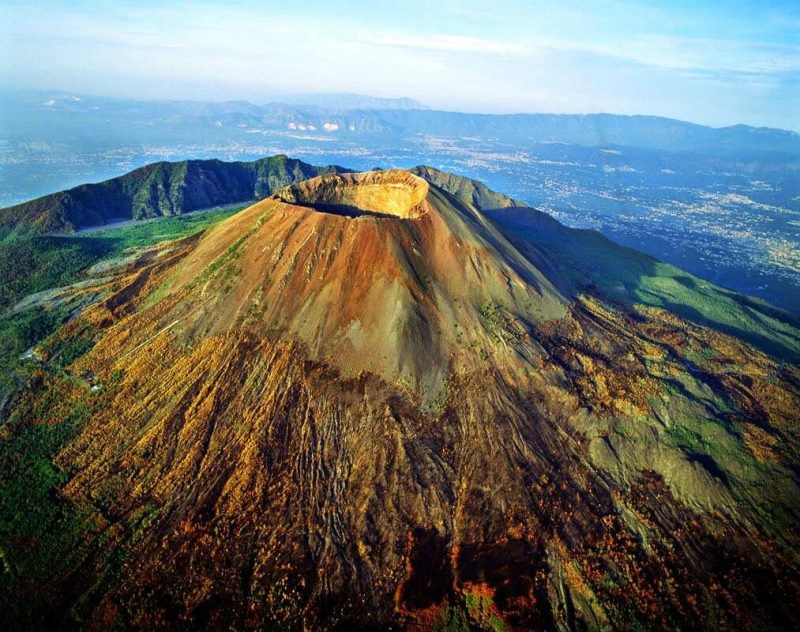
The powerful volcano Vesuvius has repeatedly demonstrated its destructive power, bringing death and destruction. One of the terrible examples is the event of 1631, when the volcano killed at least 4,000 people. There were also strong eruptions in 1794, 1822, 1872 and 1906. The last known eruption of Vesuvius took place in 1944, which caused serious damage to many buildings in nearby cities. Fortunately, the number of victims was relatively small at that time, and amounted to 27 people.
Interesting facts
Vulcan Vesuvius, 1281 meters high, is part of the Apennine mountain range, which stretches along the entire Italian peninsula. This volcano has a unique structure, consisting of concentric cones. The outer cone, known as Monte Somma, reaches a height of 1,132 meters, but half of its crater has collapsed. The next cone, simply called Vesuvius, is young. The diameter of its round crater is about 700 meters, and its depth reaches more than 200 meters. Inside Vesuvius, as a result of past eruptions, a third cone periodically appeared and disappeared. Nowadays, its traces can be considered only among scientists and specialists.
Vesuvius is an active volcano, which implies the presence of magmatic cavities at a shallow depth (about 3 km) and the ability to show its activity for many years.
Italy is known for its three active volcanoes, including Etna (on the island of Sicily) and Stromboli (located on one of the islands of the Aeolian archipelago). Interestingly, among this trio, Vesuvius is considered the "quietest" volcano. At least in the last hundred years, Vesuvius has shown its activity much less often than Etna.
Vesuvius National Park
Vulcan Vesuvius in Italy is one of the most popular tourist attractions. In 1995, its surroundings were declared a national park-reserve, covering an area of approximately 8,500 square meters. The land around Vesuvius is rich and fertile, so gardens and vineyards are grown here. On the higher slopes, you can find coniferous and mixed forests, partially planted to prevent landslides. Starting at a height of 900 meters, the rocky soil will make the area almost desert.
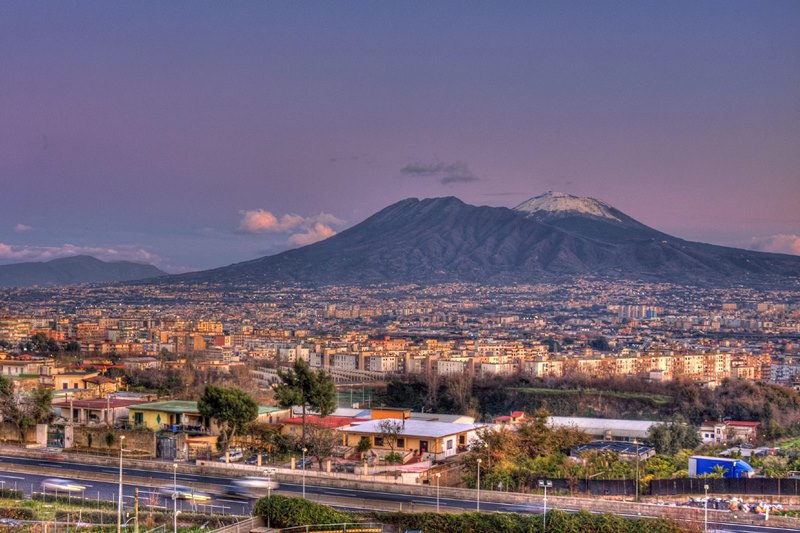
On the northwestern slope of the volcano there is an observatory, where experts carefully monitor the activity of Vesuvius.
At the end of the 19th century, a funicular was built to climb this mountain, but the eruption of the volcano in 1944 completely destroyed it. Later, a chair lift was erected, but after a strong earthquake in 1980, it stopped functioning. Thus, to reach the top, you have to walk. It should be noted that this journey will not be easy: the road is steep, and there is no shelter from the scorching sun, and the sand inexorably penetrates the shoes. However, for those who decide to conquer this climb, there will be a magnificent view of the coastline, the city of Naples and the island of Capri. A footpath with a wooden railing is laid along the edge of the crater, which allows you to go around the crater.


