
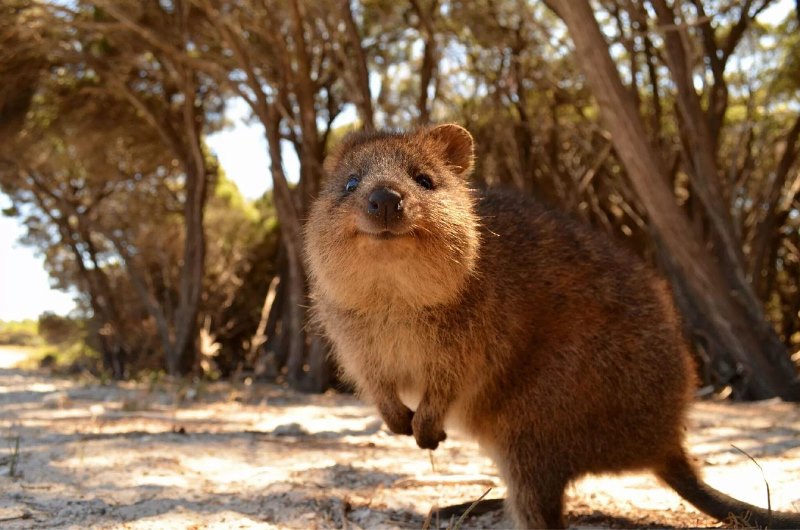
Australia is a unique continent, home to many amazing creatures. Some of them can only be found here in this part of the world, while others remain virtually unknown to us. In this publication, we will tell you about the funniest and most unusual inhabitants of the Australian fauna, which will make your visit to this amazing and unique country truly unforgettable.
Kangaroo

The kangaroo has long been an Australian icon. Red kangaroos in particular have little to no fear of humans, making them surprisingly easy to observe. These animals move with the help of powerful hind legs and long jumps, which gives them a certain resemblance to humans in an upright position. Kangaroos have short front legs, while their hind legs are strong and long, and their tail is also long and powerful.
Huge ears allow them to perceive even the faintest sounds. Males often fight using their front paws, but in the heat of passion they can attack using all four paws, including the tail.
A baby kangaroo is born in an extremely helpless state, which forces the female to carry it in a special pouch on her stomach. This tiny kangaroo comes into the world naked and with its eyes closed, weighing just one gram and measuring just two centimeters. In a warm and safe bag, it develops and grows for eight months.
Kangaroos have well-developed front legs, which allows them to dexterously manipulate objects. They move by making long jumps, and despite their weight, which can reach 70 kilograms, they move very quickly. Tree kangaroos, on the other hand, are much smaller than regular kangaroos and prefer to live in the forest, being in the trees.
Platypus

This unique creature is immediately noticeable with its large, spatulate beak, giving it some bird-like characteristics. Surprisingly, the female platypus lays eggs enclosed in a flexible film, more reminiscent of a bird's egg. She then carries them in her nest, like a real bird, spending about ten days in this process. However, despite all the avian analogies, the platypus is a mammal. Her cubs are born completely hairless and blind. To feed them, the female lies on her back, and the babies lick the milk flowing from her pores. When they grow up, the female takes them to the water, where they learn to hunt small animals. The platypus' burrow is always located on the shore of a body of water.
It is amazing how easily and gracefully the platypus swims, which only enhances its similarity to aquatic birds. Its paws are webbed and its body is aerodynamically shaped. However, on land it moves much more clumsily. The platypus hunts for only about an hour, preferring to do it early in the morning or late in the evening. Its diet includes worms, fish, larvae, crustaceans and other aquatic treasures. Its beak, wide and flat, resembles that of a duck. But he has no teeth at all, only two keratinized tubercles on his tongue that help grind food using his beak.
Koala

This fluffy creature looks like a small teddy bear, but it weighs only fifteen kilograms. The koala prefers trees and almost never descends to the ground. Thanks to its sharp claws, the koala masterfully jumped through the trees and deftly moves from branch to branch. Its food is eucalyptus leaves, and in a day it can eat about a kilogram of foliage. Surprisingly, the koala distinguishes old leaves from young ones, since young eucalyptus foliage is poisonous.
Koala is a real acrobat and dexterous animal. He easily jumps from branch to branch and from one tree to another, without fear of a possible fall. This creature spends its life on the treetops, descending only when the distance between the trees is too great. In addition, there is no need to worry about the possibility of parasites from the koala, as its fur emits the scent of eucalyptus, which repels parasites.
Kuzu

This is a small marsupial that is active at night and can often be seen walking along forest peaks. This amazing creator deftly moves through the trees using its powerful tail, like monkeys. It feeds on a variety of plant foods, including flowers, bark and tree leaves, but sometimes does not refuse bird eggs. Kuzu prefers a lifestyle in large and sociable packs, which often settle near human residential areas.
Echidna

At first glance, the echidna resembles a large hedgehog with unusually long spines. Its weight varies from 2.5 to 5 kilograms. A unique feature of the echidna is its narrow, long beak, which reaches a length of 7.5 centimeters and can be either straight or slightly curved. This unusual beak is suitable for exploring the narrow crevices of burrows, from which the echidna extracts its food using its sticky and long tongue. Her mouth is located precisely at the end of this beak and is surprisingly small, devoid of teeth and opens only 5 millimeters.
The peculiarity of this beak is its sensitivity; with its help, the echidna is able to respond to even the most imperceptible movements of the electromagnetic field emanating from small animals. This, one might say, is a kind of “extrasensory perception.” The female echidna lays just one egg and then carries it in a pouch on her stomach. The newborn cub feeds by licking the milk secreted by the mother. The echidna's sharp, long spines serve as excellent defense, and it has almost no natural enemies, except in rare cases when it is hunted by Australians, who view it as game.
Tasmanian devil

The name "Tasmanian devil" sounds terrifying, but outwardly this animal is not at all so scary. It is about the size of a small dog. But its black fur, massive jaws and sometimes aggressive behavior caused fear among the early colonists of Tasmania, leading to its irresistible nickname "Tasmanian devil" or "marsupial devil".
Tasmanian devils hunt at night and prefer to hide in dense bushes during the day. In battle, they prove to be aggressive opponents, and can even defeat larger opponents, including dogs. However, their aggressive behavior may be due to their limited interactions with other species. If you catch a Tasmanian devil at a young age, it can be tamed and made into a docile companion.
Proboscis-headed cuscus or honey possum

Nectar is believed to be a gift from the gods, but even some animal connoisseurs have found a way to enjoy it. In desert conditions, any available food is valued, so the proboscis-headed couscous chooses nectar as its food source. It has a long snout and uses special brushes to collect nectar.
Wombat

The wombat is an amazing creature that can be easily tamed by humans, despite its caution and shyness. Outwardly, this animal resembles a large hamster, and its largest representatives can reach a length of one meter and twenty centimeters and weigh up to forty kilograms.
Australians adore wombats for their cute and friendly nature and even keep them as pets. But despite their herbivorous diet, wombats should be handled with care. If threatened, they can defend themselves with their claws and teeth. Meeting a wombat in the wild is also not easy, since they are active only at night and spend time in their burrows during the day. Wombat encounters can occur in South Australia, like Victoria.
How to see these beautiful creatures in person?
It's actually very simple on one hand - just take a trip to Australia! Then the nuances of where and how begin. Given the significant distance between Australia and Ukraine, the best way to get there is by air. You will have to take a flight with one or two transfers. Australia's international airports are in cities such as Sydney, Melbourne and Brisbane. Your journey will begin with departure or departure from Kyiv, Warsaw, Chisinau with subsequent transfers in cities such as Amsterdam, Paris, Frankfurt and others.
The cutest animals in Australia, excursions and zoo parks
To get acquainted with the rich animal world of Australia, it is recommended to visit Sydney Zoo. The famous Taronga Zoo, one of the largest in the world, has existed for almost a century. About three thousand animals live here, many of which are endangered.
Phillip Island offers amazing encounters with Australian nature. Here you can visit the koala breeding center and witness a unique parade. In the evening, at sunset, hundreds of little penguins emerge from the sea and head towards the dunes, where they will spend the night. Here they feed their chicks and fall asleep under the magical sunset rays, not paying attention to the enthusiastic tourists who watch them.
Phillip Island is also famous for its nature park, where you can find a variety of Australian animals, including koalas, wallabies, kangaroos and wombats. And the largest Australian colony of fur seals lives on the Seal Rocks; about twenty thousand of them live here!
If you are interested in the animal world of Australia, then you can visit a variety of excursions, such as the Australian Animal Park in Sydney, a safari in Lamington National Park south of Brisbane, trips to Stradbroke Island, visits to Creland Animal Park, excursions to Kangaroo Island and the Flinders Ranges, as well as trips to the Daintree and Woorunuron National Parks. Australia invites you on an exciting journey through its unique nature.


